April 3
American Circus Day
An entertainment observance on April 3 celebrating the history, artistry, and cultural legacy of circus performance in the United States.
Unknown
Historical Origin
No documented founder or formal establishment record has been identified. The date commemorates John Bill Ricketts's first circus performance in the United States, held in Philadelphia on April 3, 1793.

Introduction
The date on the calendar traces back to a specific afternoon in 1793, when a British horseman named John Bill Ricketts opened a roofless wooden arena in Philadelphia and staged the first circus performance in the United States. President George Washington was in the audience within weeks.
American Circus Day marks the start of an entertainment tradition that would grow from one 42-foot ring into a continent-spanning industry of acrobats, aerialists, and trained animals. The circus shaped American popular culture for more than two centuries, and its influence is still evolving today.
American Circus Day History
Before circus acts reached American shores, the format had already been invented in London. Philip Astley, a former British cavalry sergeant, began performing equestrian tricks in a circular ring near Westminster Bridge in 1768. He discovered that riding in a tight circle created centrifugal force that helped him stay balanced during stunts.
Astley standardized his ring at 42 feet in diameter, a measurement still used in circus rings around the world. He added rope-dancers, clowns, and acrobats between the riding acts, creating the mixed-bill entertainment format that defined the circus for the next 250 years.
Ricketts Brings the Circus to America
John Bill Ricketts, a Scottish-born equestrian who had trained in Astley's London circle, arrived in Philadelphia in 1792 and opened a riding school. Within months, he built a roofless wooden arena at the corner of Market and Twelfth Streets, fitted with a 42-foot ring filled with soil and sawdust.
On April 3, 1793, Ricketts staged the first American circus performance for roughly 800 spectators. The bill included his own riding tricks, his brother Francis on horseback, a rope-dancer named Spinacuta, and a clown called Mr. McDonald. President George Washington attended a performance on April 22 of the same year.
The Big Top Goes Mobile
For the next three decades, American circuses performed in fixed wooden buildings or roofless arenas. That changed in 1825, when showman Joshuah Purdy Brown staged his show under a portable canvas tent. The tent freed circuses from the cities and sent them rolling into small towns across the country.
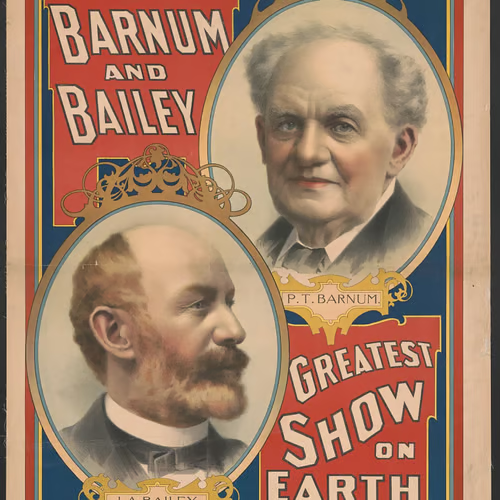
P.T. Barnum entered the circus business in 1871, expanding the format into a three-ring spectacle that traveled by railroad. By the 1880s, his partnership with James A. Bailey produced the Barnum and Bailey Circus, which employed over 1,000 people and traveled in roughly 85 railroad cars.
The Rise and Fall of the Greatest Show
Five of the seven Ringling brothers launched their own traveling circus in 1884 from Baraboo, Wisconsin. In 1907, they purchased the Barnum and Bailey operation for $400,000. The two shows merged in 1919, creating the combined Ringling Bros. and Barnum and Bailey Circus.
The combined show dominated American entertainment for decades, but the industry gradually shrank as television, theme parks, and animal welfare concerns drew audiences elsewhere. Feld Entertainment, which had owned the show since 1967, closed it in May 2017. In September 2023, the company reopened the circus with an all-new, animal-free production.
American Circus Day Timeline
Philip Astley stages modern circus
Ricketts opens first U.S. circus
Canvas tent replaces fixed venues
Ringling and Barnum shows merge
Ringling Bros. closes after 146 years
Animal-free revival launches
How to Celebrate American Circus Day
- 1
Visit the Circus Hall of Fame
The International Circus Hall of Fame in Peru, Indiana, preserves wagons, costumes, and memorabilia from American circus history. The museum sits on the former winter quarters of the American Circus Corporation.
- 2
Watch a contemporary circus performance
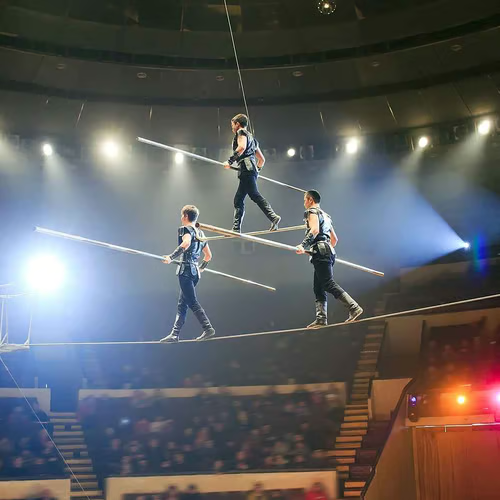
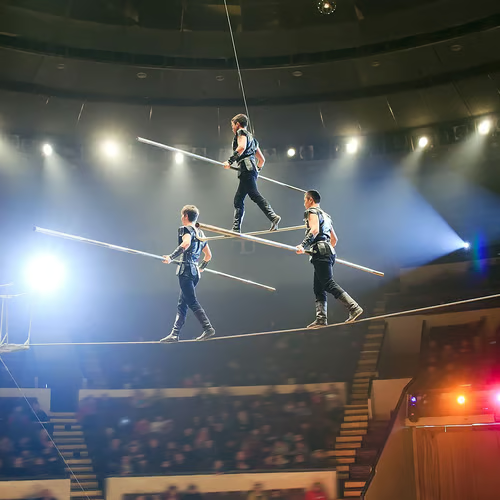
Companies like Cirque du Soleil and the revived Ringling Bros. have reimagined the circus as a human-focused art form. Check local venues for touring shows that blend acrobatics, aerial work, and theatrical storytelling.
- 3
Explore the Ringling Museum collections
The John and Mable Ringling Museum of Art in Sarasota, Florida, houses the Tibbals Learning Center, which includes a massive miniature circus model with over 44,000 pieces. The museum also holds circus posters and artifacts from the Ringling era.
- 4
Read a firsthand account of circus history
The Circopedia encyclopedia offers detailed, sourced entries on performers, venues, and circus innovations dating back to the 1700s. Start with the entry on John Bill Ricketts to trace the origin of American circus performance.
- 5
Try a circus skills class
Many cities have circus arts schools that offer beginner classes in trapeze, juggling, aerial silks, or tightwire walking. A single session is enough to appreciate the physical training behind even the simplest-looking acts.
Why We Love American Circus Day
- A
It preserves a founding moment of American entertainment
Ricketts's 1793 Philadelphia performance established circus as the first mass commercial entertainment in the new republic. The format predates vaudeville, motion pictures, and professional sports leagues as a paid spectator experience.
- B
It documents the evolution of live performance ethics
The circus industry's shift away from animal acts reflects broader changes in public attitudes toward animal welfare. The 2023 Ringling revival, featuring 75 human performers from 18 countries and no animals, represents the most visible example of this transformation.
- C
It shaped the infrastructure of touring entertainment
American circuses pioneered the logistics of moving large-scale productions by rail, a model later adopted by rock concerts, Broadway tours, and traveling exhibitions. At its peak, the Ringling operation transported over 1,000 employees and hundreds of animals in 90 to 100 double-length train cars.
Holiday Dates
| Year | Date | Day |
|---|---|---|
| 2023 | Monday | |
| 2024 | Wednesday | |
| 2025 | Thursday | |
| 2026 | Friday | |
| 2027 | Saturday |