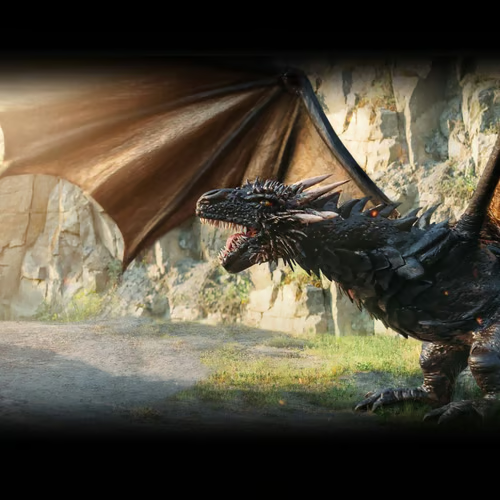

January 16
Appreciate a Dragon Day
An annual observance on January 16 celebrating dragons in mythology, literature, and popular culture.
Donita K. Paul
Individual Initiative
Author Donita K. Paul created Appreciate a Dragon Day in 2004 to coincide with the release of her fantasy novel Dragonspell, the first book in the DragonKeeper Chronicles.

Introduction
Appreciate a Dragon Day was created to make a case: dragons deserve more than background monster roles in adventure stories. Fantasy author Donita K. Paul established the day in 2004 to coincide with the release of her debut novel Dragonspell, arguing that dragons are among the most complex and culturally significant creatures in world mythology.
The argument holds up. Dragons appear in the recorded mythology of every inhabited continent, from Mesopotamian creation epics to Chinese imperial culture to the fire-breathing wyrms of Old English poetry. No other mythological creature has maintained this level of cross-cultural presence for over four thousand years.
Appreciate a Dragon Day History
Dragons are among the oldest creatures in recorded mythology. The Babylonian Enuma Elish (~2100 BC) describes Tiamat, a primordial sea dragon whose body was split to form the heavens and earth. By the time the Beowulf poet composed the oldest surviving fire-breathing dragon in English literature (8th-11th century), dragon stories had already been circulating across Mesopotamian, Greek, and Norse cultures for millennia.
These traditions split along geographic lines. In China, the loong evolved into a wingless water deity associated with rain, rivers, and imperial authority. In Europe, the 12th-century Golden Legend popularized Saint George slaying a dragon, embedding the creature as a Christian symbol of evil. The same word, "dragon," came to mean opposite things depending on where you lived.
From epic poetry to modern fantasy
J.R.R. Tolkien bridged these ancient traditions and modern fiction. A professional Beowulf scholar at Oxford, he drew directly from the Beowulf dragon and the Norse Fafnir when he created Smaug for The Hobbit in 1937. Smaug became the template for modern fantasy dragons, influencing Anne McCaffrey's Dragonriders of Pern (1968), Ursula K. Le Guin's Earthsea series, and eventually George R.R. Martin's A Song of Ice and Fire.
The holiday's creation
Donita K. Paul, a Christian fantasy author working in the tradition Tolkien established, created Appreciate a Dragon Day in 2004 to mark the release of her debut novel Dragonspell. The book launched a five-part series called the DragonKeeper Chronicles, published through WaterBrook Press. Paul chose January 16 as the date, and the observance has since spread through holiday calendar sites independently of the book series.
Appreciate a Dragon Day Timeline
Tiamat appears in Babylonian myth
Fafnir recorded in Norse sagas
Saint George legend spreads
Tolkien publishes The Hobbit
Appreciate a Dragon Day is created
Game of Thrones premieres on HBO
How to Celebrate Appreciate a Dragon Day
- 1
Read the book that started the holiday
Start Donita K. Paul's Dragonspell, the novel whose release prompted the creation of Appreciate a Dragon Day. It is the most direct way to observe the day as the founder intended.
- 2
Compare Eastern and Western dragons
Read the Britannica entry on dragons to see how the same creature evolved into opposite symbols across civilizations: benevolent water deities in China, destructive fire-breathers in Europe.
- 3
Read a dragon origin text
Pick up a translation of the Beowulf dragon scene, the Volsunga Saga's Fafnir chapters, or the Golden Legend's Saint George story. These are the primary sources that modern fantasy draws from, and they read differently than their adaptations.
- 4
Browse dragon art across cultures
Search 'dragon' in the Metropolitan Museum of Art's online collection to see how Chinese, Japanese, European, and Islamic artists depicted dragons across centuries of visual art.
- 5
Watch a dragon film and trace its influences
Stream How to Train Your Dragon, Reign of Fire, or House of the Dragon and identify whether the dragons draw from Eastern or Western traditions, Tolkien's Smaug template, or something entirely original.
Why We Love Appreciate a Dragon Day
- A
It highlights the deepest cultural divide in mythology
Chinese dragons (loong) are benevolent water deities symbolizing prosperity and imperial power; the five-clawed dragon was reserved exclusively for the emperor. European dragons are fire-breathing symbols of greed and evil. The same creature carries opposite meanings depending on the civilization, making dragons one of the clearest examples of how mythology reflects the values of the society that creates it.
- B
It draws attention to a direct literary lineage
The holiday was created by an author in a tradition that runs from Beowulf through Tolkien through modern fantasy. That lineage is documented and traceable: Tolkien studied Beowulf professionally, used it to build Smaug, and every dragon-centric novel since (including the DragonKeeper Chronicles) builds on that foundation. The holiday makes that chain visible.
- C
It separates mythology from pop culture assumptions
Most people encounter dragons through films and games that standardize them as winged, fire-breathing reptiles. The actual mythological record is far more varied: wingless Chinese water spirits, poison-breathing Norse dwarves-turned-serpents, Babylonian chaos goddesses. The day encourages looking past the Hollywood version to the original source material.
Holiday Dates
| Year | Date | Day |
|---|---|---|
| 2023 | Monday | |
| 2024 | Tuesday | |
| 2025 | Thursday | |
| 2026 | Friday | |
| 2027 | Saturday |