
March 23
Atheist Day
An annual observance on March 23 recognizing atheism and promoting awareness of secular perspectives, religious freedom, and the separation of church and state.
Spanish Union of Atheists and Freethinkers
Community Origin
The Spanish Union of Atheists and Freethinkers first celebrated Atheist Day on March 23 in 2009. Multiple international organizations, including Atheist Republic and the International Coalition of Ex-Muslims, subsequently adopted the date. A satirical internet story from 2003 had previously placed the observance on April 1; the March 23 date was chosen to separate it from that mockery.

Introduction
Atheist Day exists in part because of an internet joke. In 2003, a satirical story went viral claiming a judge had told an atheist plaintiff that April Fools' Day was already their holiday. The story was fictional, but it stuck. When secular organizations formalized the observance in 2009, they deliberately chose March 23 to distance it from the punchline.
The holiday now serves a more substantive purpose. The share of Americans identifying as atheist has doubled since 2007, and the broader category of religiously unaffiliated adults has reached 28% of the population. Atheist Day marks a demographic shift that is reshaping American civic life.
Atheist Day History
Atheism in America did not start in the 21st century. The period from 1860 to 1900 is known as the Golden Age of Freethought, when public intellectuals openly questioned religious authority and traveled a national lecture circuit that drew large audiences. The movement had enough momentum that by 1925, the American Association for the Advancement of Atheism became one of the country's first formal organizations dedicated to nonbelief.
The American Humanist Association followed in 1941, broadening the secular movement beyond atheism into a philosophical framework that emphasized ethics without religion. These organizations laid the groundwork, but atheism remained largely invisible in mainstream American life. That changed with one person.
The most hated woman in America
Madalyn Murray O'Hair was a Baltimore mother who challenged the practice of mandatory Bible reading in her son's public school. Her case, Murray v. Curlett, reached the Supreme Court in 1963, where it was consolidated with Abington School District v. Schempp. The Court ruled that officially mandated Bible reading in public schools was unconstitutional.
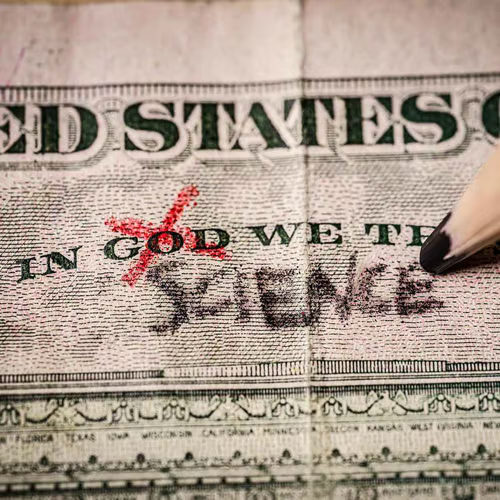
That same year, O'Hair founded American Atheists. In 1964, Life magazine called her "the most hated woman in America." She was confrontational, litigious, and unapologetic. She pursued cases to remove "In God We Trust" from currency and to revoke tax exemptions for churches. She remained the public face of American atheism until her death in 1995.
From internet joke to formal observance
In 2003, a satirical internet story claimed a judge had told an atheist plaintiff that April Fools' Day was already their holiday, citing the biblical verse "The fool says in his heart, 'There is no God.'" The story was entirely fictional, but it spread widely enough to permanently link atheism with April 1 in popular culture.
When the Spanish Union of Atheists and Freethinkers organized the first formal Atheist Day in 2009, they chose March 23 specifically to break that association. The date gave the observance its own identity, separate from any punchline. Organizations including Atheist Republic and the International Coalition of Ex-Muslims subsequently adopted it, turning March 23 into a global day of visibility for nonbelievers.
Atheist Day Timeline
First atheist advocacy group founded
Supreme Court bans mandatory school prayer
Satirical Atheist Day story goes viral
First formal Atheist Day observed
Atheists reach 4% of U.S. adults
How to Celebrate Atheist Day
- 1
Read the Supreme Court decision
The full text of Abington School District v. Schempp is available online. The 1963 ruling redefined the relationship between religion and public education in the United States and remains one of the most cited First Amendment cases.
- 2
Learn about the demographics of nonbelief
Explore Pew Research Center's data on religious demographics in America. The numbers reveal how rapidly the religious landscape is changing and how atheism intersects with age, education, geography, and politics.
- 3
Watch a debate or lecture
Find recorded public debates between theists and atheists, or watch lectures from prominent secular thinkers. The intellectual tradition of public argumentation about religion is centuries old and remains one of the most substantive forms of civic discourse.
- 4
Support a secular organization
Organizations like the Freedom From Religion Foundation and American Atheists work on church-state separation cases and provide legal support for nonbelievers. Atheist Day is an opportunity to learn about their work.
- 5
Have an honest conversation
If you are comfortable doing so, talk to someone about what you believe and why. Atheist Day is designed to normalize open discussion about nonbelief, not to convert anyone but to make the conversation itself less unusual.
Why Atheist Day is Important
- A
The nonreligious population is growing faster than any faith group
Pew Research data shows that religiously unaffiliated Americans, the 'nones,' grew from under 10% in the 1990s to 28% in 2023. Within that group, self-identified atheists doubled from 2% to 4% between 2007 and 2023. Approximately two-thirds of nones are former believers. Atheist Day marks a demographic trend that is accelerating.
- B
It addresses ongoing legal and social challenges
Despite constitutional protections, atheists in the United States face social stigma and, in some states, outdated laws that technically bar nonbelievers from holding public office. Seven state constitutions still contain religious test provisions, even though they are unenforceable under the federal Constitution. Atheist Day draws attention to the gap between legal rights and social acceptance.
- C
It connects to a global movement for freedom of belief
Atheist Day is observed internationally, with particular significance in countries where apostasy carries criminal penalties. The International Coalition of Ex-Muslims uses March 23 to show solidarity with atheists who face persecution for leaving religion. The observance links American secular advocacy with a global human rights issue.
Holiday Dates
| Year | Date | Day |
|---|---|---|
| 2023 | Thursday | |
| 2024 | Saturday | |
| 2025 | Sunday | |
| 2026 | Monday | |
| 2027 | Tuesday |