
May 2
Baby Day
A lighthearted observance on May 2 celebrating babies and the milestones, science, and cultural significance of early human development.
Unknown
Community Origin
No documented founder or formal establishment record has been identified for Baby Day. The observance circulates on holiday calendar sites with a May 2 date, but primary archives do not trace a specific creator or inaugural event.

Introduction
Baby Day focuses on one of biology's most remarkable subjects: human infants. Newborns arrive with roughly 300 bones (about 94 more than adults), no solid kneecaps, and a brain that will double in size before their first birthday.
The science of infant development has accelerated sharply in recent decades. Researchers now know that babies begin recognizing their mother's voice in the womb, can distinguish between languages within days of birth, and process faces using the same neural pathways as adults by four months old. Baby Day highlights a subject where the research consistently outpaces public awareness of just how much is happening inside an infant's brain.
Baby Day History
Public concern for infant welfare in the United States stretches back more than a century. In 1914, Chicago organized one of the country's first Baby Weeks, a citywide campaign to promote infant health through home visits, public lectures, and improved access to clean milk. By 1916, the effort had expanded into a national movement.
The backdrop was grim. In the early 1900s, roughly one in ten American infants died before their first birthday, driven by contaminated milk, poor sanitation, and limited medical knowledge about newborn care.
Incubators and the Fight for Survival
The technology that changed premature infant survival came from an unlikely source. In 1880, French obstetrician Stéphane Tarnier adapted a poultry warming chamber into a wooden box with a hot water bottle and glass lid, creating the first infant incubator. At the Port Royal maternity hospital in Paris, his device cut premature infant mortality roughly in half.
American hospitals were slow to adopt the technology. Dr. Martin Couney, frustrated by institutional resistance, resorted to exhibiting premature babies in incubators at Coney Island and world's fairs from 1903 onward. Despite the ethical concerns, Couney's exhibitions saved an estimated 6,500 infants over four decades and pushed hospitals to build their own units.
Modern Neonatal Medicine
The first dedicated neonatal intensive care unit in the United States opened at Yale New Haven Hospital in 1960, designed by Dr. Louis Gluck. That milestone marked the beginning of neonatology as a medical specialty. By the 1970s, NICUs had become standard in hospitals across the developed world, and infant mortality rates fell sharply.
In 2024, the U.S. infant mortality rate stood at approximately 5.5 per 1,000 live births, a dramatic decline from the 100-per-1,000 rates common in the early 1900s.
Baby Day as a Modern Observance
No documented founder or establishment record exists for Baby Day as observed on May 2. The date appears on holiday calendar listings without traceable primary evidence of who created it or when it began. It joins a broader tradition of informal observances that celebrate early childhood, fitting alongside more formally established events like Baby Safety Month.
Baby Day Timeline
First infant incubator developed
National Baby Week launches
U.S. Baby Boom begins
First American NICU opens
U.S. fertility hits record low
How to Celebrate Baby Day
- 1
Review your child's developmental milestones
The CDC's child development resources outline specific skills children typically develop at each age, from head control to first words. Checking milestones helps identify potential delays early, when intervention is most effective.
- 2
Donate to a neonatal care organization
Groups like the March of Dimes fund research into premature birth, birth defects, and infant health outcomes. Even small donations contribute to programs that support NICU families and advance neonatal science.
- 3
Assemble a baby care kit for a local shelter
Contact a nearby family shelter or crisis center to ask what supplies are most needed for infants, typically diapers, wipes, formula, and onesies. Assembling a kit provides tangible support to families navigating difficult circumstances.
- 4
Read about infant brain development
The Zero to Three organization publishes research-backed resources on how early experiences shape neural connections. Understanding the science behind infant cognition can change how caregivers interact with babies daily.
- 5
Create a baby time capsule
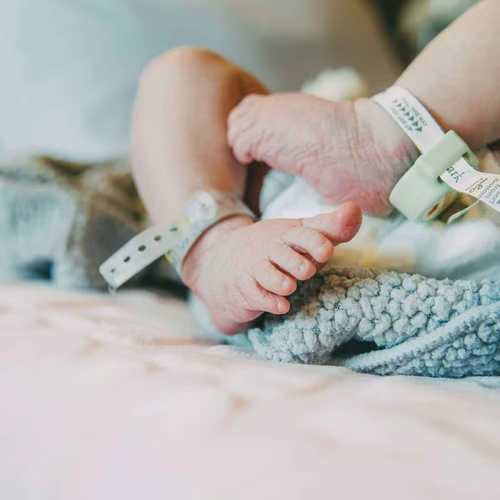
Collect small items that represent the day a child was born or a family milestone: a newspaper front page, a hospital bracelet, a handwritten note. Sealing them in a box to open on a future birthday turns a simple exercise into a lasting family tradition.
Why We Love Baby Day
- A
It reflects a global demographic reality
Approximately 140 million babies are born worldwide each year, roughly 385,000 per day. In the United States, the total fertility rate dropped to a record low of 1.599 in 2024, a figure that shapes policy discussions around labor, healthcare, and social safety nets.
- B
It highlights a century of medical progress
The U.S. infant mortality rate dropped from roughly 100 per 1,000 live births in the early 1900s to approximately 5.5 per 1,000 in 2024. That decline reflects advances in neonatal care, vaccination, nutrition, and public sanitation that unfolded across the entire twentieth century.
- C
It draws attention to early developmental science
A baby's brain reaches about 80 percent of its adult size by age three, making the first years a critical window for neural development. Research from institutions like the CDC and the National Institutes of Health has established specific developmental milestones that guide pediatric care worldwide.
Holiday Dates
| Year | Date | Day |
|---|---|---|
| 2023 | Tuesday | |
| 2024 | Thursday | |
| 2025 | Friday | |
| 2026 | Saturday | |
| 2027 | Sunday |