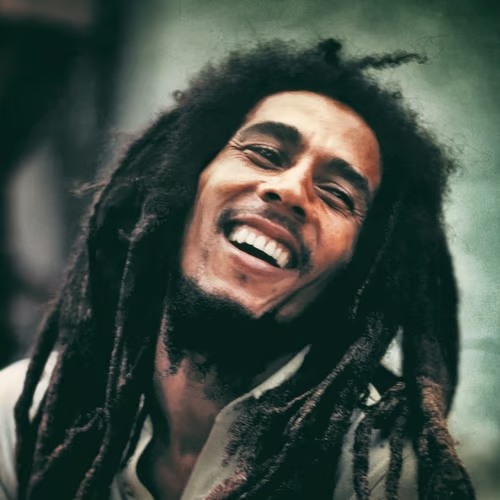
February 6
Bob Marley Day
An annual observance on February 6 honoring the life, music, and cultural legacy of Jamaican reggae pioneer Bob Marley.
Government of Jamaica
Government Proclamation
Bob Marley's February 6 birthday has been celebrated informally since his death in 1981. In 2008, the Government of Jamaica proclaimed February as Reggae Month, with Marley's birthday serving as the centerpiece of the national celebration.

Introduction
Bob Marley Day honors the man who turned reggae from a Jamaican street sound into a global musical language. Marley sold an estimated 75 million records worldwide before his death at 36 and has continued to sell millions more in the decades since, a commercial durability almost unmatched in popular music.
His greatest hits album _Legend_, released three years after his death, became the best-selling reggae album in history with over 12 million copies sold internationally. Beyond the music, Marley's fusion of Rastafari spirituality, postcolonial politics, and deeply personal songwriting gave reggae an ideological weight that no other popular genre carried at the time.
Bob Marley Day History
Reggae music emerged in Jamaica in the late 1960s, evolving from the earlier ska and rocksteady styles. The shift came as Jamaican musicians slowed tempos and emphasized the offbeat rhythm guitar, creating a sound that would become one of the most recognizable in modern music. Bob Marley was at the center of that transition.
Marley grew up in Trench Town, a neighborhood in Kingston known for both its poverty and its concentration of musical talent. In 1963, he formed The Wailers with Peter Tosh and Bunny Wailer, and by 1964, their single "Simmer Down" hit number one in Jamaica, selling an estimated 70,000 copies.
From Kingston to the World
The Wailers signed with Island Records in 1972, gaining their first significant international platform. The albums Catch a Fire and Burnin' introduced reggae to audiences across Europe and North America. After Tosh and Wailer left, the group became Bob Marley and the Wailers, and the 1975 live recording of "No Woman, No Cry" broke through commercially.
In 1976, Marley agreed to headline the Smile Jamaica concert, a government-backed event aimed at easing political violence in Kingston. Two days before the show, seven armed men entered his home and shot Marley, his wife Rita, and his manager. All survived. Marley performed a 90-minute set for 80,000 people two days later, appearing on stage with his wounds still bandaged.
The One Love Peace Concert
After spending 16 months in self-imposed exile in London, Marley returned to Jamaica in 1978 for the One Love Peace Concert. During a performance of "Jamming" at the National Stadium, he called Prime Minister Michael Manley and opposition leader Edward Seaga onto the stage and joined their hands above his head before 35,000 people. The gesture became one of the most iconic moments in Caribbean political history.
Marley died of cancer on May 11, 1981, at the age of 36. He was awarded Jamaica's Order of Merit three months before his death.
Bob Marley Day and Reggae Month
Celebrations of Marley's February 6 birthday became a fixture of Jamaican cultural life after his death. In 2008, the Government of Jamaica formally proclaimed February as Reggae Month, with Marley's birthday and that of Dennis Brown (February 1) serving as the anchoring dates. The Recording Industry Association of Jamaica (RIAJam) proposed the designation, and Governor-General Sir Kenneth Hall read the proclamation at King's House on January 24, 2008.
Bob Marley Day Timeline
Bob Marley born in Nine Mile
The Wailers form in Kingston
Exodus album released
Rock and Roll Hall of Fame
Grammy Lifetime Achievement Award
Reggae Month proclaimed in Jamaica
How to Celebrate Bob Marley Day
- 1
Listen to Marley's key albums in order
The official Bob Marley website documents the chronological arc from Catch a Fire through Uprising. Hearing the albums in sequence reveals how his sound, lyrics, and political consciousness evolved across a single decade.
- 2
Visit the Bob Marley Museum in Kingston
The Bob Marley Museum at 56 Hope Road occupies Marley's former home and studio, including the room where the 1976 assassination attempt took place. Guided tours cover his life, music, and the history of the Rastafari movement.
- 3
Watch the One Love biopic
The 2024 film Bob Marley: One Love follows Marley's life from the 1976 shooting through the creation of the Exodus album in London. Watching it alongside the actual album provides context for how exile shaped some of his most enduring work.
- 4
Read about reggae's UNESCO recognition
In 2018, UNESCO inscribed Reggae Music of Jamaica on its Intangible Cultural Heritage list. The inscription document details how reggae emerged from Jamaican communities and spread worldwide as a vehicle for social commentary.
- 5
Explore the Rastafari movement's history
Marley's music is inseparable from Rastafari, the spiritual movement that shaped his worldview, imagery, and message. Understanding its origins in 1930s Jamaica and its connections to pan-Africanism adds depth to the lyrics and symbolism in Marley's catalog.
Why We Love Bob Marley Day
- A
It marks reggae's entry into global culture
Marley sold an estimated 75 million records and introduced reggae to audiences on every continent. In 2018, UNESCO inscribed Reggae Music of Jamaica on its Representative List of the Intangible Cultural Heritage of Humanity, citing its role in international discourse on injustice and resistance.
- B
It preserves the legacy of music as political action
Marley's 1978 One Love Peace Concert physically united two warring political leaders on stage during a period of violent civil conflict in Jamaica. His music directly addressed colonialism, poverty, and racial injustice, establishing a model for how artists could use popular culture as a platform for political engagement.
- C
It anchors Jamaica's largest cultural export
Reggae generates significant economic activity for Jamaica through tourism, live performance, and intellectual property. The Bob Marley Museum at 56 Hope Road in Kingston draws visitors from around the world, and Reggae Month concerts and events contribute directly to the island's cultural tourism economy.
Holiday Dates
| Year | Date | Day |
|---|---|---|
| 2023 | Monday | |
| 2024 | Tuesday | |
| 2025 | Thursday | |
| 2026 | Friday | |
| 2027 | Saturday |