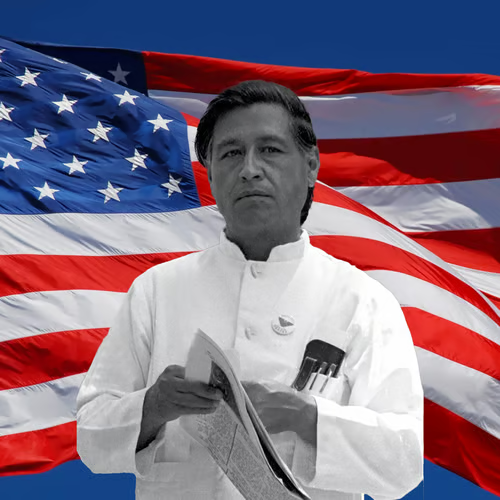
March 31
Cesar Chavez Day
A heritage observance on March 31 commemorating the birthday and labor legacy of Cesar Chavez, now facing proposed renaming in multiple jurisdictions following sexual abuse allegations reported in March 2026.
California State Senator Richard Polanco
Legislative Resolution
California SB 984, authored by Senator Richard Polanco and signed by Governor Gray Davis on August 18, 2000, made March 31 a paid state holiday for state employees, teachers, and judges to commemorate Cesar Chavez's birthday and legacy.

Introduction
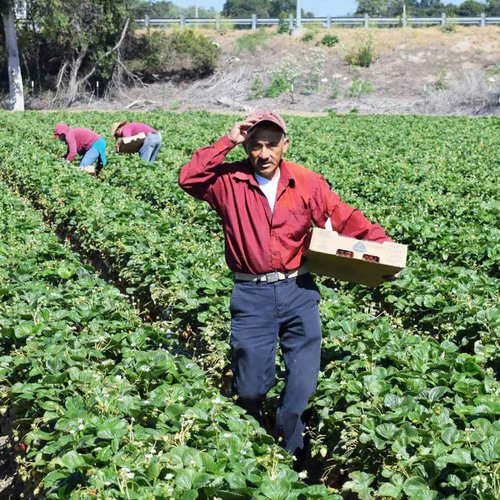
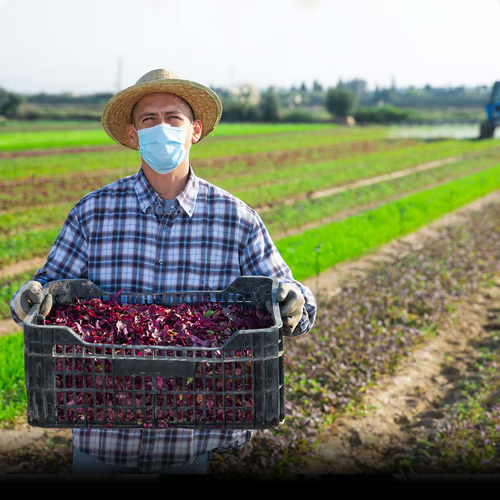
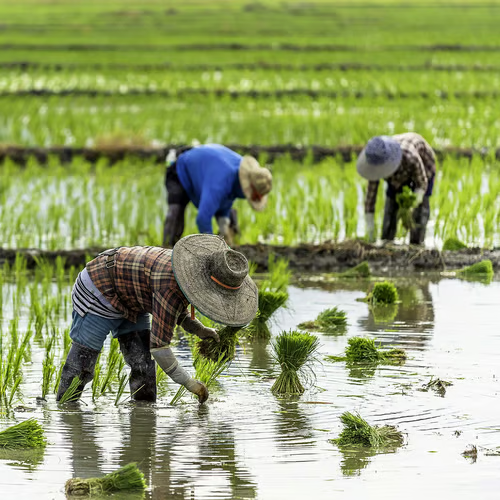
Cesar Chavez Day commemorates the labor leader who co-founded the United Farm Workers and organized migrant farmworkers into one of the most visible civil rights movements in American history. His campaigns brought national attention to pesticide exposure, poverty wages, and living conditions that had been largely invisible to urban America.
In March 2026, that legacy was fundamentally disrupted. A New York Times investigation reported that Chavez had groomed and sexually abused two underage girls in the 1970s. In a separate allegation, Dolores Huerta, his most prominent labor ally, accused him of rape. Within days, California lawmakers introduced a bill to rename the holiday to "Farmworkers Day," and the governors of Texas and Arizona cancelled their state observances. As of March 19, 2026, the proposed renaming has not yet been enacted, but the holiday's future is actively being reconsidered across multiple jurisdictions.
Cesar Chavez Day History
Cesar Chavez was born on March 31, 1927, near Yuma, Arizona, to a family of Mexican immigrants. During the Great Depression, the family lost their farm and became migrant workers in California's Central Valley. That experience shaped his understanding of the exploitation farmworkers faced: poverty wages, dangerous pesticide exposure, no access to bathrooms or clean water in the fields, and no legal protections.
After serving in the U.S. Navy, Chavez became a community organizer in the 1950s before focusing entirely on farmworker advocacy.
Building the Union
In 1962, Chavez co-founded the National Farm Workers Association with Dolores Huerta and Gilbert Padilla. The organization merged with Larry Itliong's Agricultural Workers Organizing Committee in 1966 to form the United Farm Workers (UFW). The Delano grape strike, which began on September 8, 1965, became the movement's defining campaign. Filipino farmworkers under Itliong walked off the vineyards first; Chavez's predominantly Mexican membership joined a week later.
The strike lasted five years. The UFW organized consumer boycotts that spread nationally, and Chavez undertook a 25-day hunger strike in 1968 that drew support from Senator Robert F. Kennedy. In July 1970, major grape growers signed collective bargaining agreements, delivering tangible improvements in wages and conditions for thousands of farmworkers.
From Movement Leader to State Holiday
Chavez continued organizing until his death on April 23, 1993, at age 66. His legacy grew substantially in the decades that followed. In 2000, California became the first state to establish March 31 as a paid holiday, with Governor Gray Davis signing SB 984 into law. Texas, Colorado, Arizona, and several other states later adopted their own observances. President Obama proclaimed March 31 as Cesar Chavez Day at the federal level in 2014. Nearly 50 California schools carried his name, along with hundreds of streets, parks, and public buildings across the Southwest.
The 2026 Reckoning
In March 2026, a New York Times investigation reported that Chavez had groomed and sexually abused two underage girls during the 1970s. In a separate allegation, Dolores Huerta, the co-founder he had worked alongside for decades, accused Chavez of raping her. The accusations prompted immediate responses from state and local governments.
The governors of Texas and Arizona cancelled their state observances of March 31 within 24 hours. In California, Assembly Speaker Robert Rivas and Senate leader Monique Limón introduced a bill to rename the holiday to "Farmworkers Day." Los Angeles Mayor Karen Bass signed a proclamation removing Chavez's name from the city's observance. Officials across multiple states began evaluating the roughly 50 schools, streets, and public spaces bearing Chavez's name.
As of March 19, 2026, the California renaming legislation had not yet been enacted, and the holiday remains officially named Cesar Chavez Day at the state level. The proposed bill would require two-thirds votes in both chambers and the governor's signature to take effect before March 31. The legislation reflects a deliberate effort to preserve the holiday's purpose, honoring the broader farmworker movement, while separating it from the individual whose conduct contradicted the movement's values.
Cesar Chavez Day Timeline
National Farm Workers Association founded
Delano grape strike begins
Grape growers sign contracts
California establishes state holiday
Abuse allegations prompt proposed renaming
How to Celebrate Cesar Chavez Day
- 1
Learn the full history of the farmworker movement
Visit the Cesar E. Chavez National Monument site, maintained by the National Park Service, which documents the UFW's organizing campaigns, the Delano grape strike, and the broader history of farmworker labor in the United States.
- 2
Support farmworker advocacy organizations
Contribute to or volunteer with organizations like the Farmworker Justice organization, which advocates for improved wages, working conditions, and immigration policy for agricultural laborers. The farmworker movement's achievements depend on continued institutional support.
- 3
Read the reporting that reshaped the holiday
Review the New York Times investigation that prompted the 2026 proposed renaming. Understanding the evidence and the responses it generated provides necessary context for how societies reassess historical figures when new information emerges.
- 4
Explore the contributions of other movement leaders
Research the roles of Dolores Huerta, Larry Itliong, Gilbert Padilla, and other organizers whose contributions were often overshadowed by Chavez's public profile. The Dolores Huerta Foundation continues community organizing work rooted in the same principles the farmworker movement established.
- 5
Buy directly from farmworker-owned cooperatives
Use the day to shift purchasing toward agricultural cooperatives and farmworker-owned operations. Supporting these businesses provides direct economic benefit to the workers the holiday was created to recognize, connecting consumer choices to the labor conditions the observance addresses.
Why Cesar Chavez Day is Important
- A
The farmworker movement produced lasting labor protections
The UFW's campaigns led directly to the California Agricultural Labor Relations Act of 1975, the first law in the United States granting farmworkers the right to organize and bargain collectively. Regardless of how Chavez's personal legacy is reassessed, the structural changes his movement achieved remain in effect and continue to affect millions of agricultural workers.
- B
The proposed renaming models institutional accountability
California's proposed legislation to rename the holiday to Farmworkers Day rather than simply abolish it demonstrates how institutions can attempt to acknowledge harm without erasing the contributions of an entire movement. If enacted, the legislative response would separate the individual from the collective achievement, preserving historical recognition while refusing to honor a figure credibly accused of sexual abuse.
- C
Farmworker labor conditions remain a present-day issue
The Department of Labor estimates that there are roughly 2.4 million farmworkers in the United States, many of whom still face challenges including wage theft, pesticide exposure, and limited access to healthcare. Whether the holiday is called Cesar Chavez Day or Farmworkers Day, it draws attention to a workforce whose labor conditions remain among the most demanding in the American economy.
Holiday Dates
| Year | Date | Day |
|---|---|---|
| 2023 | Friday | |
| 2024 | Sunday | |
| 2025 | Monday | |
| 2026 | Tuesday | |
| 2027 | Wednesday |