
May 16
Drawing Day
An arts observance on May 16 celebrating drawing as a creative skill and encouraging people of all abilities to pick up a pencil and sketch.
Unknown
Community Origin
No documented founder or formal establishment record has been identified. The observance first appeared around 2008 as a grassroots initiative within the online art community, encouraging people to create and share drawings on a single designated day.

Introduction
Drawing Day falls on May 16 and marks an annual invitation to pick up a pencil, pen, or crayon and put marks on a surface. The act it celebrates is among the oldest forms of human expression: a cross-hatched ochre pattern found in South Africa's Blombos Cave dates to roughly 73,000 years ago, predating written language by tens of thousands of years.
The observance grew out of a grassroots push that surfaced around 2008, when artists and enthusiasts began designating a single spring day for sharing original sketches online. No formal institution claims credit for Drawing Day, but it has since spread across social media platforms and art communities worldwide, attracting participants who range from professional illustrators to people who haven't drawn since grade school.
Drawing Day History
The human impulse to draw predates every other recorded form of communication. In 2018, researchers working in Blombos Cave on the southern coast of South Africa identified a cross-hatched pattern drawn with a red ochre crayon on a silcrete flake. The find was dated to approximately 73,000 years ago, making it the oldest known drawing.
Figurative cave art followed much later. A painted Sulawesi warty pig discovered in an Indonesian cave has been dated to at least 45,500 years ago, while Europe's Chauvet Cave in France contains more than 1,000 animal drawings that are roughly 36,000 years old. These sites demonstrate that drawing was a foundational tool for storytelling and ritual long before writing systems existed.
Drawing as a Formal Discipline
When paper arrived in Europe during the 1100s, drawing shifted from a rare skill into a trainable craft. By the 1400s, Renaissance workshops in Florence and Rome treated drawing, or disegno, as the intellectual foundation of all visual arts. Apprentices spent years mastering proportion and shading before they were permitted to touch paint.
Leonardo da Vinci embodied this philosophy most fully. He produced approximately 2,500 drawings across his notebooks, ranging from anatomical cross-sections to flying machine prototypes. His small silverpoint sketch "Head of a Bear" sold for $12.2 million at Christie's in 2021, one of fewer than eight da Vinci drawings still in private hands.
A Modern Observance Takes Shape
Organized advocacy for drawing as a public activity gained momentum in 2000, when the Guild of St George launched the Campaign for Drawing in the United Kingdom. That initiative grew into The Big Draw, a month-long October festival now held internationally. Separately, Drawing Day appeared around 2008 as a grassroots online event tied to May 16, inviting anyone to sketch something and share it. No single founder has been identified, and the observance has spread primarily through social media and art community networks.
Drawing Day Timeline
Paper reaches Europe
Da Vinci's anatomical sketches begin
Campaign for Drawing launches
Drawing Day emerges online
Drawing effect confirmed in study
How to Celebrate Drawing Day
- 1
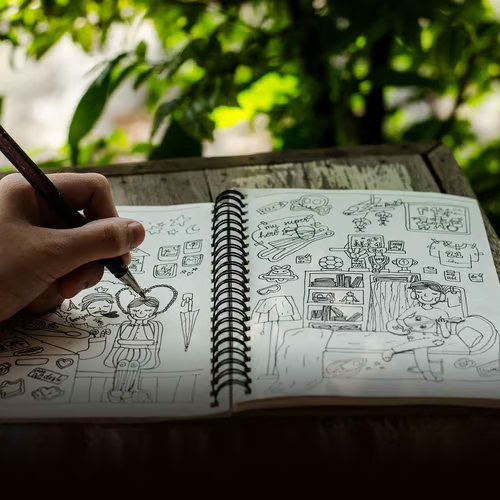
Sketch your surroundings for 30 minutes
Set a timer and draw whatever is directly in front of you, whether it is a coffee cup, a tree, or a room corner. Observational drawing builds the habit of visual attention that researchers link to stronger memory and focus.
- 2
Try a free online drawing lesson
Platforms like Khan Academy's Pixar in a Box offer structured exercises that teach shading, perspective, and character design. Even a single 20-minute session can introduce techniques that make drawing feel less intimidating.
- 3
Visit a museum's drawing collection
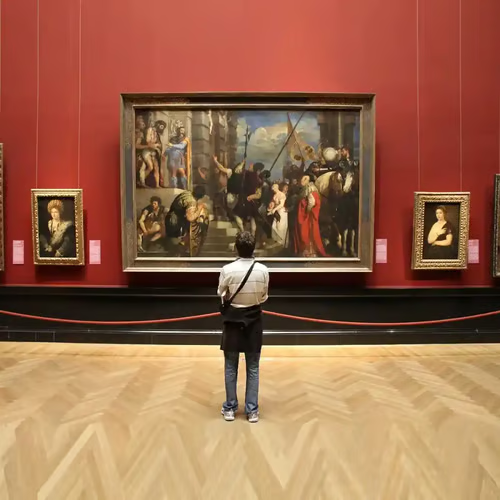
Many major institutions display original master drawings. The Metropolitan Museum of Art's Drawings and Prints department holds more than 21,000 works on paper dating from the Renaissance to the present.
- 4
Donate supplies to a local school
Sketchbooks, pencils, and erasers are among the first supplies cut when art budgets shrink. Contact a nearby school or afterschool program and ask what drawing materials students need most.
- 5
Host a group drawing session
Organize a Big Draw-style event at a library, cafe, or community center where participants sketch a shared subject. Group drawing sessions lower the pressure on individual output and often produce surprising collaborative results.
Why We Love Drawing Day
- A
Drawing strengthens memory encoding
University of Waterloo researchers found that subjects who drew concepts recalled them significantly better than those who wrote notes, because drawing simultaneously engages visual, spatial, verbal, and motoric processing. The effect held across age groups and did not depend on artistic skill, suggesting drawing is a broadly accessible learning tool.
- B
It preserves an ancient communication form
Drawing preceded written language by tens of thousands of years, serving as the primary medium for recording observations, stories, and rituals. Drawing Day connects modern participants to this lineage, reinforcing drawing's status as one of humanity's most enduring cognitive tools.
- C
It counters declining arts education access
A 2019 report from Americans for the Arts found that 40% of U.S. school districts had cut visual arts instruction over the preceding decade. An annual observance that encourages anyone to draw, regardless of formal training, provides a low-barrier entry point to creative practice outside classroom settings.
Holiday Dates
| Year | Date | Day |
|---|---|---|
| 2023 | Tuesday | |
| 2024 | Thursday | |
| 2025 | Friday | |
| 2026 | Saturday | |
| 2027 | Sunday |