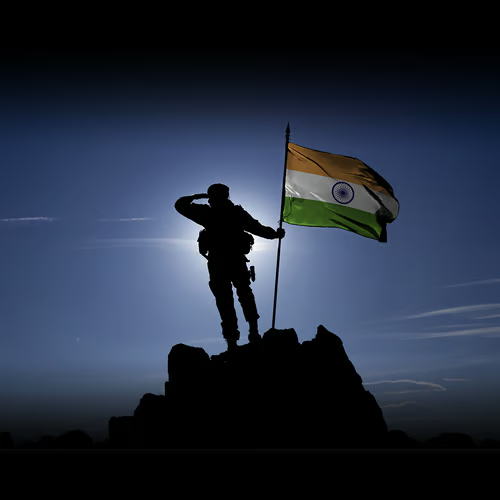
January 15
Indian Army Day
A national military observance on January 15 honoring the service, valor, and sacrifices of Indian Army personnel in defense of the nation.
Indian Army
Historical Origin
Indian Army Day has been observed on January 15 since 1949, marking the date Lieutenant General K.M. Cariappa succeeded General Sir Francis Bucher as the first Indian Commander-in-Chief of the Indian Army.

Introduction
When Lieutenant General K.M. Cariappa accepted command of the Indian Army on January 15, 1949, he inherited a force that had served under British leadership for over a century but had never been led by one of its own. Indian Army Day marks that transfer of command, a turning point that completed the military dimension of Indian independence less than 18 months after Partition.
Born in the hill country of Kodagu, Karnataka, Cariappa had spent three decades climbing through a system built to keep Indian officers from senior command, making his final promotion both a personal vindication and a national one. The observance now serves as both a reckoning with how military sovereignty was forged and a platform for recognizing the soldiers who maintain it.
Indian Army Day History
The Indian Army's roots stretch back to the mid-1700s, when the British East India Company raised local infantry and artillery units to protect its commercial operations across the subcontinent. By the 1850s, the Company's forces numbered more than 250,000 soldiers, a standing army larger than Britain's own. After the Indian Rebellion of 1857, the British Crown took direct control, and the three Presidency Armies were formally unified into a single Indian Army in 1895.
Indian soldiers fought in both World Wars in large numbers, yet British officers held nearly every senior command position. Political pressure for homegrown leadership led to the Indianization policy, which began reserving officer slots for Indian cadets at Sandhurst starting in 1918.
The Push for Indian Officers
The pace of change was slow. In 1923, only eight army units were designated for Indian-officered command under what became known as the Eight Unit Scheme. A breakthrough came in 1932 with the opening of the Indian Military Academy in Dehra Dun, modeled on Sandhurst and designed to produce Indian Commissioned Officers on home soil.
K.M. Cariappa, who had been among the first batch of King's Commissioned Indian Officers in 1919, rose through these ranks as both a trailblazer and a combat leader.
Independence and the Transfer of Command
When India gained independence in August 1947, the army was still commanded by a British officer, General Sir Rob Lockhart, who was soon succeeded by General Sir Francis Bucher. Cariappa, already distinguished for leading Indian forces on the Western Front during the 1947 war with Pakistan, was the clear choice to succeed Bucher. On January 15, 1949, the formal handover took place, ending nearly two centuries of foreign command over Indian troops.
Army Day Takes Shape
That date became the anchor for an annual military observance. Each year, the Chief of Army Staff reviews a grand parade and presents gallantry decorations. For decades, the ceremony was held at the Cariappa Parade Ground in Delhi Cantonment, a venue renamed in honor of the first Indian Commander-in-Chief.
Starting in 2023, the Indian Army began rotating the main event to different cities to widen public engagement, with Pune, Lucknow, and Jaipur hosting in successive years.
Indian Army Day Timeline
British Indian Army formally unified
Indian Military Academy opens
First Indian Commander-in-Chief appointed
Cariappa conferred Field Marshal rank
First woman commands parade contingent
Parade moves beyond Delhi
How to Celebrate Indian Army Day
- 1
Visit the National War Memorial in New Delhi
The National War Memorial in central New Delhi commemorates every Indian soldier who has died in conflict since independence. Walk through the Param Yoddha Sthal, where busts of the 21 Param Vir Chakra recipients are displayed.
- 2
Watch the Army Day parade broadcast
The annual parade features infantry contingents, armored vehicle displays, and combat demonstrations reviewed by the Chief of Army Staff. The event is broadcast live on Doordarshan's official YouTube channel, making it accessible from anywhere.
- 3
Read a firsthand account of Indian military history
Pick up Field Marshal Sam Manekshaw's biography or K.M. Cariappa's memoirs for a ground-level view of the army's transformation from colonial force to sovereign institution. Both accounts cover the 1947 war and the leadership transition that followed.
- 4
Contribute to the Armed Forces Flag Day Fund
India's Armed Forces Flag Day Fund supports ex-servicemen, war widows, and their dependents. Contributions go directly toward rehabilitation, medical aid, and educational grants for veterans and military families.
- 5
Explore the Indian Military Academy's public exhibits
The IMA campus in Dehra Dun, where India's officer corps has trained since 1932, opens select areas to visitors during events and exhibitions. Check local schedules for guided tours of the Chetwode Building and war memorabilia displays.
Why Indian Army Day is Important
- A
It anchors India's post-colonial military identity
The January 15 observance commemorates the precise moment India assumed sovereign command of its own armed forces. That transition completed the institutional independence that political independence alone could not guarantee.
- B
It sustains recognition of the world's second-largest army
With approximately 1.25 million active personnel, the Indian Army operates across some of the most demanding terrain on earth, from the Siachen Glacier at 20,000 feet to dense jungle in the northeast. Army Day provides an annual platform to acknowledge the scale and readiness of that commitment.
- C
It preserves the legacy of military firsts
K.M. Cariappa was the first Indian to attend the Staff College at Quetta, the first to command a battalion, and one of only two officers ever conferred the rank of Field Marshal. The observance keeps these milestones visible in a country where the armed forces operate under strict political neutrality and rarely seek public attention.
Holiday Dates
| Year | Date | Day |
|---|---|---|
| 2023 | Sunday | |
| 2024 | Monday | |
| 2025 | Wednesday | |
| 2026 | Thursday | |
| 2027 | Friday |