April 23
Movie Theatre Day
An annual observance on April 23 celebrating the movie theater experience, from projected films and shared audiences to the architecture and culture of cinema venues.
Unknown
Community Origin
No documented founder or formal establishment record has been identified for Movie Theatre Day. The April 23 date coincides with the 1896 premiere of the Vitascope projector at Koster and Bial's Music Hall in New York City, a landmark event in the history of projected cinema in the United States.

Introduction
Movie Theatre Day falls on the anniversary of America's first projected film screening, but the observance is less about that 1896 debut and more about what the venue became. Within a decade of its invention, the movie theater evolved from a converted storefront with wooden chairs into the defining entertainment destination of the 20th century, a transformation no other medium has matched in speed or cultural reach.
What makes the format endure is partly economic and partly sensory. A single bucket of popcorn generates a higher profit margin for a theater than any ticket sale, a business model that has subsidized moviegoing since the 1940s. Meanwhile, the auditorium itself, engineered for calibrated light levels, THX-certified acoustics, and screens that can span 100 feet, creates a viewing environment that even the best home projector cannot approximate.
Movie Theatre Day History
The story of the movie theater begins with a race to project moving images for a paying audience. In Paris on December 28, 1895, Auguste and Louis Lumière screened ten short films at the Grand Café, charging one franc per viewer. Within months, the technology crossed the Atlantic.
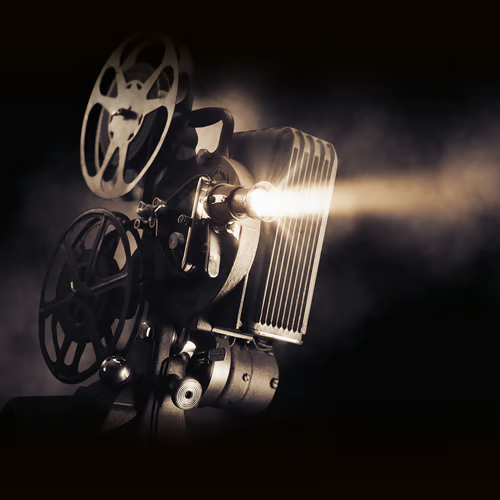
On April 23, 1896, a device called the Vitascope debuted at Koster and Bial's Music Hall on 34th Street in Manhattan. Advertised as "Thomas Edison's Latest Marvel," the projector was actually built by Thomas Armat and C. Francis Jenkins; Edison's company manufactured and marketed it under a licensing agreement. Audiences watched waves crashing on a beach, a boxing match, and a dancer with an umbrella, all projected onto a 20-foot screen embedded in the vaudeville stage.
From storefronts to movie palaces
The Vitascope launched a fast-moving industry. By July 1896, Vitascope Hall opened in New Orleans as the first venue in the United States dedicated exclusively to showing motion pictures. But the real tipping point came in 1905, when Harry Davis and John P. Harris opened a storefront theater on Smithfield Street in Pittsburgh.
They called it the "Nickelodeon," combining the five-cent admission price with the Greek word for theater. Shows ran from 8 a.m. to midnight, and within five years an estimated 10,000 nickelodeons were operating across the country, making movies the first mass entertainment medium accessible to working-class Americans.
Sound, spectacle, and survival
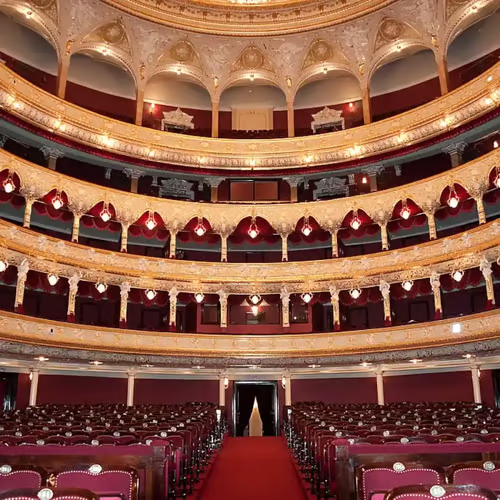
The nickelodeon era gave way to the silent film palaces of the 1910s and 1920s: ornate venues like the Strand Theatre in New York (1914), which seated over 3,000 and featured lobbies, grand staircases, and live orchestras. When Warner Bros. released The Jazz Singer in 1927, introducing synchronized dialogue, the industry pivoted again. By the early 1930s, virtually all feature films included sound, and theaters rushed to install speaker systems.
The theatrical business peaked in 1946, when over 80 million Americans attended weekly. Television eroded that dominance through the 1950s, prompting Hollywood to counter with widescreen formats like CinemaScope and immersive technologies that a living room could not match. The multiplex model, pioneered by Nat Taylor in Ottawa in 1963, allowed theaters to show multiple films simultaneously and has remained the industry's dominant format ever since.
Movie Theatre Day Timeline
Lumière brothers hold first screening
Vitascope premieres in New York City
First nickelodeon opens in Pittsburgh
The Jazz Singer introduces sound
Theater attendance reaches its peak
First multiplex theater opens
How to Celebrate Movie Theatre Day
- 1
Visit a historic movie theater
The League of Historic American Theatres maintains a directory of restored movie palaces across the country. Many still screen films in their original auditoriums, complete with ornate lobbies and vintage marquees.
- 2
Watch a film from cinema's first decade
The Library of Congress Edison collection includes digitized films from 1891 to 1918. Watching a one-minute 1896 Vitascope reel puts today's blockbusters in sharp perspective.
- 3
Support an independent cinema
Independent theaters operate on thin margins and depend on local audiences. Buy a ticket, a membership through Art House Convergence, or a gift card to keep a neighborhood screen running.
- 4
Explore the science of theatrical projection
The National Science and Media Museum documents how projection technology evolved from hand-cranked film reels to 4K laser systems. Trace the engineering behind the screen.
- 5
Organize a double feature with friends
Pair a classic with a modern film that it influenced. Screen the 1927 silent film Metropolis alongside Blade Runner, or Buster Keaton's The General followed by Mad Max: Fury Road. Discussing the connections between eras makes both films richer.
Why We Love Movie Theatre Day
- A
Theaters created the first mass entertainment industry
Before radio, television, or the internet, nickelodeons brought moving pictures to millions of Americans at five cents a ticket. By 1910, an estimated 26 million people visited nickelodeons weekly, establishing the economic model for commercial entertainment that every subsequent medium has followed.
- B
The shared screening experience shapes how films are made
Directors design sound mixes, aspect ratios, and pacing for darkened auditoriums with calibrated projection and surround sound. Comedies rely on contagious laughter, horror films on collective tension: audience reactions in a theater physically alter the viewing experience in ways a solo screen cannot reproduce.
- C
The industry remains a major economic engine
U.S. and Canadian theaters generated just over $9 billion in ticket sales in 2025, with roughly 769 million tickets sold. Though still about 20% below pre-pandemic levels, the theatrical window continues to anchor film financing, distribution deals, and the broader entertainment supply chain.
Holiday Dates
| Year | Date | Day |
|---|---|---|
| 2023 | Sunday | |
| 2024 | Tuesday | |
| 2025 | Wednesday | |
| 2026 | Thursday | |
| 2027 | Friday |