
August 3
National Big Forehead Day
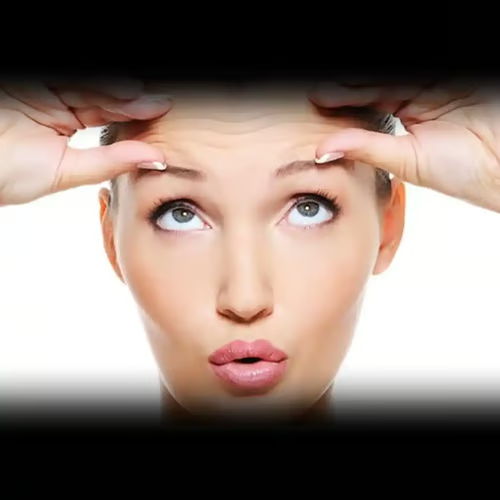
A body positivity observance on August 3 celebrating prominent foreheads and challenging narrow beauty standards around facial proportions.
Unknown
Community Origin
No verified creator has been identified for National Big Forehead Day. The observance emerged on social media around 2008 as part of the broader body positivity movement and gained traction through selfie-sharing campaigns.

Introduction
During the Renaissance, women plucked their hairlines back by up to three inches and burned follicles to prevent regrowth, all to achieve the high forehead that was considered the ultimate marker of feminine beauty. Five centuries later, a prominent forehead is more likely to be the subject of a meme than a beauty ritual, which is precisely why National Big Forehead Day exists: to reclaim a feature that has been admired, ridiculed, pseudoscientifically analyzed, and ultimately revealed to be nothing more than a matter of proportion and perspective.
The observance emerged on social media around 2008 and grew through selfie campaigns where participants proudly displayed their foreheads. The humor is deliberate, but the cultural history behind forehead perception is surprisingly deep, spanning ancient philosophy, Renaissance beauty culture, and a 19th-century pseudoscience whose vocabulary still shapes how people talk about intelligence.
National Big Forehead Day History
The cultural significance of forehead size predates recorded beauty standards. In ancient Greece, sculptors gave philosophers like Socrates and Plato disproportionately high foreheads in busts and reliefs. The artistic choice was deliberate: a prominent forehead signaled intellectual depth. In some East Asian and Indian cultural traditions, a broad forehead similarly connoted wisdom, good fortune, or noble character.
The Renaissance makes it a beauty imperative
Between the 14th and 17th centuries, the high forehead moved from a philosophical symbol to a mandatory beauty standard. European women plucked or shaved their hairlines back by as much as three inches. Some used chemical treatments to destroy hair follicles permanently. Hennin headdresses and other headwear were designed to elongate the forehead further. Paintings by artists like Rogier van der Weyden and Petrus Christus depict the ideal: smooth, rounded foreheads that suggest purity and youth.
The standard was not just aesthetic but economic. The elaborate grooming required time, resources, and access to apothecaries, making a high forehead a visible marker of wealth and status.
Phrenology turns foreheads into pseudoscience
In the late 18th century, Franz Joseph Gall proposed phrenology, the idea that the shape and size of different areas of the skull revealed mental faculties. A prominent forehead was interpreted as evidence of strong reasoning and perception. The pseudoscience was widely practiced through the mid-19th century before being discredited, but its linguistic legacy survives: the word "highbrow" still means intellectually refined, while "lowbrow" means unsophisticated.
Modern neuroscience has confirmed that forehead size has no correlation with intelligence. Cognitive ability depends on neural connectivity and brain structure, not skull proportions.
From punchline to positive
The internet era introduced the slang term "fivehead," a joke suggesting a forehead large enough to be measured in five fingers instead of four. National Big Forehead Day emerged on social media around 2008 as a response, turning the joke into a celebration. Selfie campaigns invited people to display their foreheads proudly, and the observance grew alongside the broader body positivity movement that challenges narrow beauty standards across facial features, body shapes, and skin types.
National Big Forehead Day Timeline
Greek philosophers are depicted with high foreheads
Renaissance women reshape their hairlines for beauty
Phrenology links skull shape to mental traits
'Highbrow' enters the English language
National Big Forehead Day appears on social media
Online engagement peaks
How to Celebrate National Big Forehead Day
- 1
Share a forehead-forward selfie
The original spirit of the day is selfie-based. Pull back your hair, face the camera straight on, and post without filtering. The point is not vanity but visibility.
- 2
Look at Renaissance portraits differently
Visit a museum or browse an online collection like the Metropolitan Museum of Art's digital archive and search for 15th-century European portraits. Once you know about hairline plucking, the paintings look completely different.
- 3
Learn why phrenology was wrong
The Britannica entry on phrenology explains how the pseudoscience worked, why it was popular, and the scientific methods that eventually debunked it.
- 4
Explore the history of beauty standards
Beauty standards have changed dramatically across centuries and cultures. The BBC Culture section regularly publishes features on how ideals of beauty have shifted and what those shifts reveal about the societies that held them.
- 5
Compliment a feature you've been self-conscious about
The day's broader message is about reframing features society has taught you to hide. Pick one physical feature you've been conditioned to dislike and spend the day treating it as distinctive rather than flawed.
Why We Love National Big Forehead Day
- A
Beauty standards are historically arbitrary
The same facial feature considered the peak of beauty in Renaissance Europe is mocked as a 'fivehead' on social media today. Tracking how forehead perception has changed across centuries reveals that beauty standards are cultural constructions, not fixed truths.
- B
Pseudoscience leaves lasting linguistic damage
Phrenology was debunked over a century ago, but the terms it created — 'highbrow' and 'lowbrow' — still shape how English speakers talk about intelligence and cultural taste. The words carry an implicit bias that ties physical features to mental capacity.
- C
Body positivity works best with humor
National Big Forehead Day succeeds because it uses humor rather than earnest advocacy to challenge beauty norms. The selfie campaigns and meme culture around the observance lower the barrier to participation and make body acceptance feel accessible rather than preachy.
Holiday Dates
| Year | Date | Day |
|---|---|---|
| 2023 | Thursday | |
| 2024 | Saturday | |
| 2025 | Sunday | |
| 2026 | Monday | |
| 2027 | Tuesday |