July 10
National Capybara Day
Wildlife appreciation observance on July 10 to promote awareness, enjoyment, and protection of capybaras and their habitats.
ROUS Foundation (Melanie Typaldos)
Institutional Initiative
Established by Melanie Typaldos, founder of the ROUS Foundation, to commemorate the birthday of Caplin Rous (2007–2011), her pet capybara, who achieved internet fame.

Introduction
National Capybara Day is observed on July 10 in honor of Caplin Rous, a pet capybara whose birthday on that date in 2007 became the anchor for an annual celebration founded by his owner, Melanie Typaldos, in 2011. Caplin, born in Nacogdoches, Texas, gained a documented internet following through Typaldos's blog Capybara Madness and YouTube channel, establishing him as one of the first widely recognized pet capybaras in North American digital media. The observance carries forward Typaldos's work through the ROUS Foundation for Capybara Veterinary Medicine, which she created after Caplin's unexplained death to fund health research and necropsies at Texas A&M University. The day has since attracted broader participation under the names Capybara Appreciation Day and National Capybara Day, reflecting both the memorial origin and the species' wider cultural reach.
History of National Capybara Day
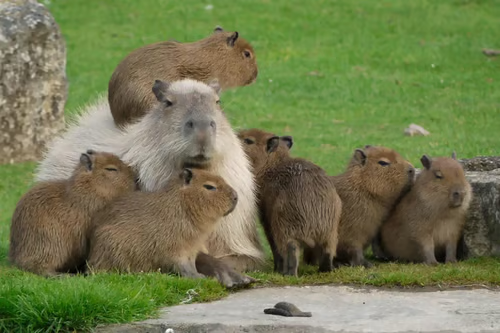
The capybara (\Hydrochoerus hydrochaeris\) takes its common name from the Old Tupi word \kapi'iûara\, meaning "grass-eater," first recorded in a European text by Portuguese explorer Gabriel Soares de Sousa in 1587. The species is native to South America and is the largest living rodent on Earth, with adults averaging around 110 pounds and capable of holding their breath underwater for up to five minutes.
Capybaras live in social groups, typically numbering between 10 and 20 individuals, and are documented interacting tolerantly with a wide range of other species. Their semi-aquatic habits, calm temperament, and visible social bonds have made them subjects of sustained interest in both zoological research and popular media.
Caplin Rous and the Birth of the Holiday
Melanie Typaldos first encountered capybaras on a trip to Venezuela, where a guide allowed her and her daughter Coral to hold a wild capybara pup. After returning home, Typaldos located a breeder and acquired Caplin Rous, who was born on July 10, 2007 in Nacogdoches, Texas. Caplin was brought to Typaldos's home when he was 11 days old, and she documented his life on the blog Capybara Madness at gianthamster.com and through a YouTube channel, where he accumulated a notable online following.
Caplin died on January 3, 2011, at approximately three and a half years of age. The cause was not definitively determined, highlighting a broader problem: most veterinarians at the time had no training in capybara care or diagnostic protocols. Typaldos held the first Caplin Day on July 10, 2011, six months after his death, choosing his birthday as the date.
The ROUS Foundation
Following Caplin's death, Typaldos founded the ROUS Foundation for Capybara Veterinary Medicine in conjunction with Texas A&M University College of Veterinary Medicine. The Foundation funds necropsies of deceased capybaras, covering shipping costs from within the United States and Canada, to build a body of data on capybara life expectancy, causes of death, and health conditions. A second capybara, Garibaldi Rous, was acquired by Typaldos and continued participating in annual Caplin Day observances through the 2010s, further documenting the tradition on the Capybara Madness blog.
Broadening of the Observance
Over time, July 10 gained secondary names including Capybara Appreciation Day and National Capybara Day. The observance spread beyond Typaldos's immediate community, with zoos, animal welfare pages, and social media accounts adopting the date. A separate and unrelated "Capybara Appreciation Day" appearing on October 13 on some aggregator calendars lacks documented primary sourcing and is distinct from the July 10 Caplin Day tradition originated by Typaldos in 2011.
National Capybara Day Timeline
Tupi name first recorded in writing
Caplin Rous born in East Texas
First Caplin Day held
ROUS Foundation established
Capybara internet fame peaks
How to Celebrate National Capybara Day
- 1
Donate to the ROUS Foundation
The ROUS Foundation for Capybara Veterinary Medicine accepts tax-deductible donations that directly fund necropsies and veterinary procedures at Texas A&M University. Contributions help build the clinical dataset that currently represents the most systematic effort to document capybara health in captivity.
- 2
Visit a capybara at a zoo or wildlife facility
Zoos in San Diego, Columbus, Chicago, Edinburgh, and London maintain capybara exhibits, and many smaller facilities in the Americas keep the species. Visiting in person provides direct observation of their semi-aquatic behavior, social group dynamics, and documented tolerance of other species that cannot be conveyed through photos.
- 3
Watch the original Caplin Day video archive
Melanie Typaldos posted annual Caplin Day videos to the Capybara Madness YouTube channel, starting with a 2012 video featuring Garibaldi Rous eating his first popsicle, a tradition rooted in Caplin's documented food preferences.
- 4
Cook a South American dish tied to capybara habitat regions
Capybaras are native to the wetlands, savannas, and river systems of Venezuela, Brazil, Colombia, and Argentina. Preparing a dish from one of these regions, such as Venezuelan pabellón criollo or Brazilian feijão tropeiro, ties the day to the ecological geography the species actually occupies.
- 5
Share verified facts about capybara biology on social media
Use the Animal Diversity Web entry for Hydrochoerus hydrochaeris as a source for accurate claims about the species, including its IUCN status, habitat range, and social structure. Posting sourced facts rather than aggregator copy helps correct persistent misinformation about the holiday's origin and the animal's conservation status.
Why We Love National Capybara Day
- A
It funds documented veterinary research
The ROUS Foundation, directly linked to the observance, provides financial support for capybara necropsies at Texas A&M University College of Veterinary Medicine, generating clinical data on captive capybara health that did not previously exist in organized form. This research has produced an anesthetic protocol that avoids nerve damage and contributed to a published dataset on capybara weight and mortality.
- B
It documents a species with localized conservation pressure
The IUCN classifies Hydrochoerus hydrochaeris as Least Concern overall, but notes that some local populations are declining due to overhunting for meat and leather, and habitat loss tied to South American wetland degradation. Annual awareness tied to this date gives conservation organizations an established cultural hook for communicating specific threats to regional capybara populations.
- C
It reflects how individual online documentation shapes species awareness
Caplin Rous's documented life on a personal blog and YouTube channel from 2007 onward represents an early instance of a captive exotic animal gaining documented public following through consistent personal publishing, preceding the broader capybara internet trend that peaked on TikTok and Instagram in 2022. The July 10 observance provides a traceable link between that early documentation and the species' current cultural prominence.
Holiday Dates
| Year | Date | Day |
|---|---|---|
| 2023 | Monday | |
| 2024 | Wednesday | |
| 2025 | Thursday | |
| 2026 | Friday | |
| 2027 | Saturday |