April 15
National Laundry Day
An annual observance on April 15 recognizing the history, technology, and labor behind the everyday task of washing clothes.
Unknown
Community Origin
No documented founder or formal establishment record has been identified for National Laundry Day. The observance circulated through online holiday calendar sites before Whirlpool Corporation promoted the April 15 date in 2019.

Introduction
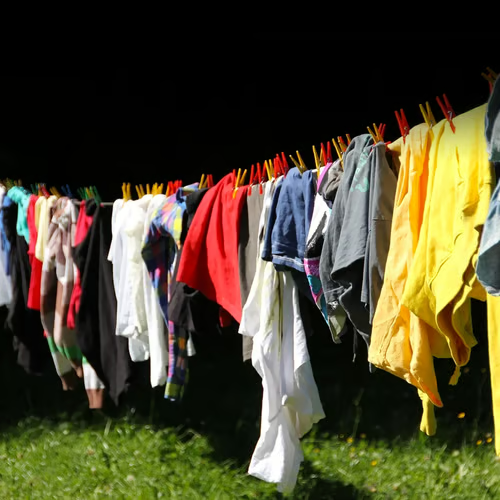
National Laundry Day falls on a task that consumed entire days before mechanization. As recently as the early 1900s, "wash day" was a fixed part of the weekly calendar, traditionally held on Mondays so clothes would be clean, pressed, and ready before the following Sunday. The process involved hauling water, boiling it over a fire, scrubbing garments against a washboard, wringing them by hand, and hanging them to dry.
The technology that replaced that labor arrived in stages: the first known washing machine design in 1767, the first electric model in 1908, and the first fully automatic machine in 1937. Today's machines use as little as 13 gallons per load, compared to nearly 50 gallons in older models, but the average American household still runs 300 to 400 loads per year.
National Laundry Day History
The act of washing clothes is among the oldest domestic tasks. Ancient civilizations cleaned garments in rivers and streams, beating them against rocks and using alkaline substances like wood ash and animal fat, the raw ingredients of the earliest soaps, which Babylonian records describe as far back as 2800 BC. For most of recorded history, laundry was performed entirely by hand and consumed extraordinary amounts of time and physical effort.
In Colonial America, washing the family's laundry could take three to four days. The process required hauling and heating large quantities of water, scrubbing garments on washboards, boiling certain items for sanitation, wringing them out, and drying them on lines. This labor fell almost exclusively on women, and for many African American women in the post-Civil War South, taking in laundry was a primary source of income.
The Washerwomen's Strike
In 1881, twenty Black laundresses in Atlanta formed the Washing Society and launched what became one of the largest labor actions in the post-Reconstruction South. Within three weeks, membership grew to 3,000, including some white laundresses. The strikers demanded a flat rate of $1 per twelve pounds of wash. Despite arrests and fines, the strike forced the Atlanta City Council to drop a proposed licensing fee and led to wage increases for some participants.
Mechanization transforms the task
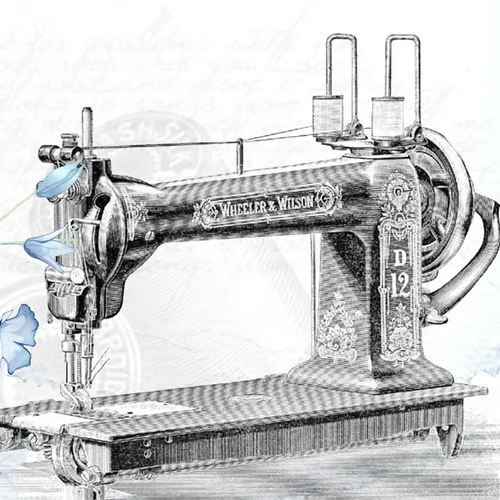
The path from manual labor to mechanization was gradual. Jacob Christian Schäffer published the first washing machine design in Germany in 1767. Nathaniel Briggs received the first U.S. patent for a washing machine in 1797, though the patent records were destroyed in the 1836 Patent Office fire. The real breakthrough came in 1908, when the Hurley Machine Company of Chicago introduced the Thor, the first commercially sold electric washing machine in the United States, with Alva J. Fisher's patent following in 1910.
Self-service and full automation
In 1934, John F. Cantrell opened the world's first self-service laundromat in Fort Worth, Texas, calling it a "Washateria." He installed four electric machines and charged customers by the hour, making machine washing accessible during the Great Depression. Three years later, Bendix Home Appliances introduced the first fully automatic domestic washing machine in 1937, eliminating the need for manual filling, agitating, and wringing.
A modern observance
National Laundry Day appeared on informal holiday calendar sites over the years, though no documented founder or formal establishment record has been identified. In 2019, Whirlpool Corporation promoted the April 15 date, connecting it to the company's long history in washing machine innovation. The observance recognizes both the technology that transformed one of humanity's oldest chores and the labor that defined it for centuries.
National Laundry Day Timeline
First washing machine design published
First U.S. washing machine patent granted
Thor electric washing machine introduced
First self-service laundromat opens
Bendix launches automatic washing machine
Whirlpool promotes April 15 date
How to Celebrate National Laundry Day
- 1
Switch to cold water for a week
Cold-water washing eliminates the 90% of energy that goes to heating water and is effective for most everyday loads. The U.S. Department of Energy recommends cold water as the default setting for routine laundry.
- 2
Audit your machine's water efficiency
Older top-loading washing machines can use up to 45 gallons per load, while modern high-efficiency front-loaders use as little as 13. Check your machine's specifications against the ENERGY STAR clothes washer guide to see how your model compares.
- 3
Read about the Atlanta Washerwomen's Strike
The 1881 Atlanta Washerwomen's Strike is one of the most significant labor actions in American history. The documented history of the strike details how 3,000 laundresses organized to demand fair wages.
- 4
Reduce microfiber shedding from your laundry
Washing synthetic fabrics at lower temperatures and using shorter cycles reduces microfiber release into wastewater. Consider adding a microfiber-catching laundry bag or filter to your routine to capture fibers before they reach waterways.
- 5
Support the Care Counts school laundry program
Whirlpool's Care Counts program installs washers and dryers in schools to help students who lack access to clean clothes. In the 2023-2024 school year, 87% of participating high-risk elementary students saw increased attendance.
Why We Love National Laundry Day
- A
Laundry is a significant source of household energy use
Heating water accounts for approximately 90% of the energy consumed by a washing machine. Switching from hot to cold water for laundry can reduce a household's carbon emissions by an estimated 864 pounds per year, making wash temperature one of the simplest levers for reducing residential energy consumption.
- B
Washing clothes releases measurable microfiber pollution
A single load of synthetic laundry can release hundreds of thousands of microfibers into wastewater, and from 1950 to 2016, an estimated 5.6 million metric tons of synthetic microfibers entered the environment from apparel washing alone. Awareness of this impact has driven demand for microfiber-catching filters and cold-water detergents.
- C
The scale of American laundry is enormous
The average American family washes approximately 300 to 400 loads of laundry per year, and washing machines account for about 17% of daily household water usage. At a national level, the U.S. laundry services market alone was valued at $15.3 billion in 2023, reflecting the economic weight of a task most people consider routine.
Holiday Dates
| Year | Date | Day |
|---|---|---|
| 2023 | Saturday | |
| 2024 | Monday | |
| 2025 | Tuesday | |
| 2026 | Wednesday | |
| 2027 | Thursday |