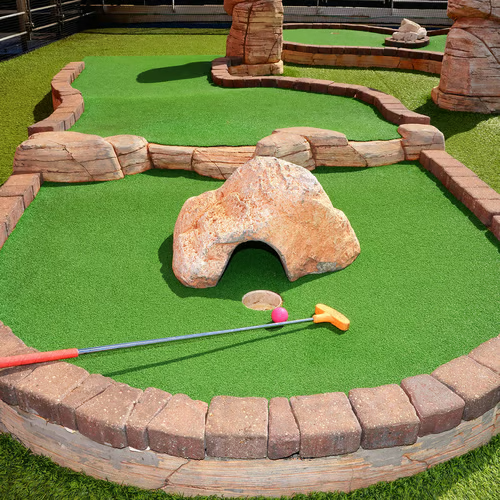

May 9
National Miniature Golf Day
A recreational observance on the second Saturday in May celebrating miniature golf, its cultural history, and its role as accessible family entertainment.
Unknown
Community Origin
The first documented observance of National Miniature Golf Day took place on May 12, 2007, and it was published in the 2008 edition of Chase's Calendar of Events. No specific founder or establishing organization has been identified.

Introduction
National Miniature Golf Day lands each year during the opening weekend of the summer entertainment season, when an estimated 18 million Americans will pick up a putter at least once before fall. The game they play has roots far older than the windmills and loop-de-loops most players associate with it: the first documented miniature course was The Himalayas at St Andrews, Scotland, built in 1867 and still in play today.
What began as a workaround for Victorian women barred from swinging a full golf club became a Depression-era craze that put over 150 courses on New York City rooftops alone. National Miniature Golf Day, observed on the second Saturday in May, marks one of the few sports that was born from exclusion and grew into one of America's most accessible pastimes.
National Miniature Golf Day Deals
3 Brands Historically Offered Deals


National Miniature Golf Day History
The game now known as miniature golf began as a concession to social convention. In 1867, the Ladies' Putting Club of St Andrews created a short course on the grounds of the famous Scottish links, allowing women to participate in golf at a time when raising a club above the shoulder was considered unladylike. That course, called The Himalayas for its undulating terrain, still operates today as the oldest known miniature golf layout in the world.
The concept crossed the Atlantic in 1916, when a course called Thistle Dhu (a play on "this'll do") opened in Pinehurst, North Carolina. It used artificial putting surfaces designed for commercial play and compact layouts that could fit on a fraction of a standard golf course.
The Tom Thumb Explosion
The game's transformation into a national pastime began in 1927 on Lookout Mountain near Chattanooga, Tennessee. Garnet Carter built a miniature course at his Fairyland Inn to keep hotel guests entertained while a full-size golf course was under construction. His wife Frieda designed the whimsical fairy-tale obstacles, and the concept proved so popular that Carter patented the Tom Thumb Golf brand and began franchising it.
By 1930, the first National Mini Golf Championship was held at Lookout Mountain with over 200 players.
The timing lined up with the invention of affordable artificial turf, patented by Thomas McCulloch Fairbairn in 1922, which freed the game from natural grass. Entrepreneurs built courses on vacant lots, in parking garages, and on rooftops.
By the early 1930s, an estimated 25,000 to 50,000 courses operated across the United States, with over 150 on New York City rooftops alone. A round cost between 10 and 25 cents.
From Depression Craze to Competitive Sport
The boom collapsed as the Depression deepened, and most courses closed. The game resurfaced in a new form in 1954, when Don Clayton, a 28-year-old insurance salesman in Fayetteville, North Carolina, built the first Putt-Putt course on Bragg Boulevard for $5,200.
Clayton stripped away the whimsical obstacles and designed a skill-based game where a well-executed putt could yield a hole-in-one on every hole. The concept took off: within three years, 106 Putt-Putt franchises were operating, and in 1959, Clayton established the Professional Putters Association.
The observance now known as National Miniature Golf Day was first celebrated on May 12, 2007, and appeared in the 2008 edition of Chase's Calendar of Events. No specific founder has been identified, but the day falls on the second Saturday in May, coinciding with the start of the outdoor entertainment season across much of the country.
National Miniature Golf Day Timeline
Ladies' Putting Club opens at St Andrews
Thistle Dhu opens in North Carolina
Tom Thumb Golf launches in Tennessee
Putt-Putt Golf founded in Fayetteville
World Minigolf Sport Federation formed
First National Miniature Golf Day observed
How to Celebrate National Miniature Golf Day
- 1
Play a round at a local course
Most miniature golf courses open for the season in May, making this an ideal weekend to visit. Search the Yelp miniature golf directory to find top-rated courses near you.
- 2
Visit a historically significant course
Several landmark courses still operate, including The Himalayas at St Andrews and original Putt-Putt layouts in North Carolina. The Putt-Putt official site lists active franchise locations across the country.
- 3
Host a backyard putting tournament
Build a temporary course using household items like cardboard ramps, plastic cups as holes, and books as bumpers. Set up a bracket, keep scorecards, and award a homemade trophy to the lowest scorer.
- 4
Explore the sport's competitive side
The World Minigolf Sport Federation maintains a calendar of sanctioned tournaments, including regional qualifiers open to amateur players. Competitive miniature golf uses standardized courses and official rules quite different from casual play.
- 5
Watch mini-golf design documentaries
Episodes of the 99% Invisible podcast and design publications have covered the Depression-era rooftop course boom and the engineering behind modern themed courses. Stream one to learn how obstacles are designed to balance skill and luck.
Why We Love National Miniature Golf Day
- A
It supports a multimillion-dollar entertainment industry
The U.S. miniature golf industry is projected to reach $484 million by 2029, with steady annual growth of 1.9%. Revenue extends beyond admission fees to food, beverages, event hosting, and merchandise, making mini-golf facilities anchor tenants in family entertainment complexes.
- B
It draws one of recreation's most balanced audiences
Approximately 18 million Americans played miniature golf in 2021, with an average participant age of 34 and a nearly even gender split at 45% female. Few recreational activities match that demographic balance, which makes mini-golf courses reliable venues for multigenerational, mixed-group outings.
- C
It sustains a sanctioned international competitive circuit
The World Minigolf Sport Federation, established in 1980, governs competitive play across 64 national associations with more than 38,000 registered players. Member organizations run over 1,500 sanctioned tournaments annually, operating under standardized rules for four recognized course systems.
Holiday Dates
| Year | Date | Day |
|---|---|---|
| 2023 | Saturday | |
| 2024 | Saturday | |
| 2025 | Saturday | |
| 2026 | Saturday | |
| 2027 | Saturday |