June 2
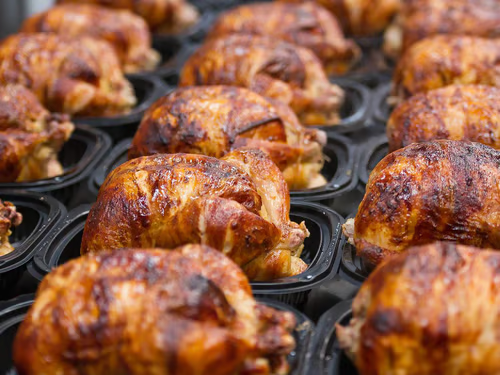
National Rotisserie Chicken Day
A U.S. observance on June 2 celebrating rotisserie-cooked chicken and its role in American home dining and convenience food culture.
Boston Market
Corporate Initiative
Boston Market Restaurants founded National Rotisserie Chicken Day in April 2015, and the National Day Calendar officially proclaimed June 2 as the annual observance date the following month.

Introduction
Americans purchased over 900 million rotisserie chickens in 2018 alone, making the slow-roasted bird one of the most consumed ready-to-eat proteins in the country. National Rotisserie Chicken Day traces its origin not to a poultry trade group or government proclamation, but to the restaurant chain that built its entire identity around the cooking method.
The technique itself predates the holiday by roughly eight centuries. Medieval French guilds formalized spit-roasting as a professional craft, and by the 1990s, American grocery stores and fast-casual restaurants had turned the rotisserie chicken into a weeknight staple. The June 2 observance, created by Boston Market in 2015, focuses that long culinary history into a single day of recognition.
National Rotisserie Chicken Day History
Spit-roasting is one of the oldest cooking methods: manuscript illustrations dating to 1338 depict fowl mounted on a hand-cranked spit over an open fire. But rotisserie cooking became a formalized profession in medieval France, where dedicated roasters served noble households as early as the 11th century.
In 1248, King Louis IX chartered the Royal Guild of Goose Roasters, granting exclusive rights to prepare and sell roasted poultry in Paris. By 1509, under Louis XII, the guild expanded to cover all meats and adopted the name Rôtisseurs. The guild received a royal coat of arms in 1610 before being dissolved during the French Revolution in 1793.
From hearth to home kitchen
For centuries, spit-roasting required a dedicated fireplace and a servant, sometimes called a "spit boy," to turn the crank for hours. Mechanical turnspit devices eventually automated the process, and by the early 20th century, electric rotisserie ovens began appearing in commercial kitchens. Napoleon Bonaparte was reportedly a devoted consumer of spit-roasted chicken, favoring it as a quick meal during military campaigns.
The American rotisserie boom
In 1985, Steven Kolow and Arthur Cores opened Boston Chicken in Newton, Massachusetts, building an entire restaurant concept around marinated rotisserie chicken served with home-style sides. Entrepreneur George Naddaff joined the venture in 1989 and expanded it into a franchise operation. By 1995, the chain had rebranded as Boston Market to reflect a broader menu, but rotisserie chicken remained its signature product.
The real market shift came from grocery stores. In 1994, Costco and Kroger introduced rotisserie chicken programs in their deli sections, selling fully cooked birds at prices that often undercut raw whole chickens. By 1998, most major American supermarkets offered rotisserie chickens, and the product had become one of the most effective loss leaders in the grocery business.
A holiday for the signature dish
In April 2015, Boston Market registered National Rotisserie Chicken Day through the National Day Calendar, and the organization proclaimed June 2 as the annual observance. The first celebration included free side dish promotions at Boston Market locations and a social media campaign under the hashtag #RotisserieChickenDay.
National Rotisserie Chicken Day Timeline
French king charters roasting guild
Rotisserie shops appear in Paris
Boston Chicken opens in Massachusetts
Supermarkets adopt rotisserie programs
National Rotisserie Chicken Day founded
Costco opens dedicated poultry plant
How to Celebrate National Rotisserie Chicken Day
- 1
Roast a chicken at home using the spatchcock method
Spatchcocking, or butterflying, a whole chicken cuts roasting time nearly in half while producing crispier skin. The technique involves removing the backbone with kitchen shears and pressing the bird flat before seasoning and roasting at high heat.
- 2
Try a Peruvian-style pollo a la brasa recipe
Peru's signature rotisserie chicken uses a marinade of soy sauce, cumin, garlic, and aji amarillo pepper, then roasts on a spit over hardwood charcoal. The FoodSafety.gov temperature chart confirms that whole chicken should reach 165°F internally, the same target whether you roast Peruvian-style or American rotisserie.
- 3
Visit a local rotisserie or smoke shop
Many independent butcher shops and rotisseries cook birds fresh on vertical or horizontal spits throughout the day. Use the Yelp rotisserie chicken search to find highly rated options near you.
- 4
Master a stock from leftover rotisserie bones
A picked-clean rotisserie carcass produces a rich homemade stock in under two hours. Simmer the bones with onion, carrot, celery, and a bay leaf, then strain and freeze in portions for future soups, risottos, and braises.
- 5
Explore the history of the Chaîne des Rôtisseurs
The modern Chaîne des Rôtisseurs, revived in 1950, is an international gastronomic society descended from the medieval French roasters guild. Its documented history traces the lineage from Louis IX's 1248 charter to today's membership across nearly 100 countries.
Why We Love National Rotisserie Chicken Day
- A
Rotisserie chicken reshaped grocery store economics
Supermarkets routinely price rotisserie chickens below cost, sometimes less than an equivalent raw bird, to draw customers who then spend more on higher-margin items. This loss-leader strategy has made the rotisserie section one of the highest-traffic areas in American grocery stores.
- B
Chicken became America's most consumed meat
U.S. per capita chicken consumption surpassed beef in 2010 and has more than tripled since 1980, rising from 32.7 pounds per person to over 98 pounds by 2022 according to USDA data. The ready-to-eat convenience of rotisserie chicken has been a significant driver of that shift.
- C
Costco built a processing plant to protect a $4.99 price
Rather than raise the price of its rotisserie chicken, Costco invested in Lincoln Premium Poultry, a vertically integrated processing facility in Fremont, Nebraska, that opened in 2019. The plant processes roughly 2 million chickens per week, giving Costco direct control over supply costs for a product it sells over 100 million units of annually.
Holiday Dates
| Year | Date | Day |
|---|---|---|
| 2023 | Friday | |
| 2024 | Sunday | |
| 2025 | Monday | |
| 2026 | Tuesday | |
| 2027 | Wednesday |