April 6
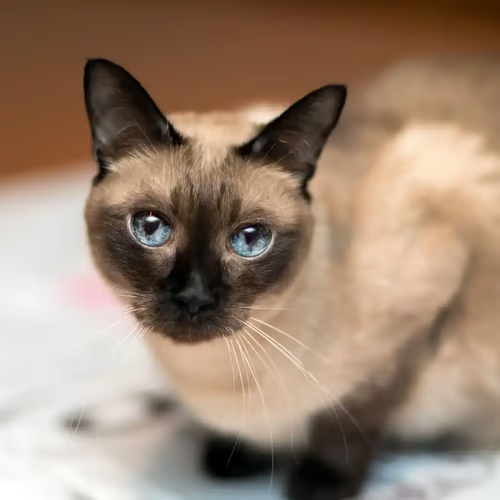
National Siamese Cat Day
An annual observance on April 6 celebrating the Siamese cat breed, its history as one of the oldest domesticated breeds from Thailand, and promoting adoption of Siamese cats from shelters.
Jace Shoemaker-Galloway
Individual Initiative
National Siamese Cat Day is widely attributed to Jace Shoemaker-Galloway, a holiday creator active since the early 2010s. No primary documentation from the founder has been identified. The earliest known listings date to approximately 2014.

Introduction
National Siamese Cat Day celebrates a breed whose distinctive appearance is the result of a genetic phenomenon you can see with your eyes. The Siamese coat pattern is caused by a temperature-sensitive mutation in the tyrosinase gene: the enzyme that produces pigment only activates in cooler areas of the body, which is why the ears, paws, tail, and face are dark while the torso stays light. Every Siamese kitten is born completely white and develops its points only after exposure to cooler temperatures outside the womb.
This is one of the oldest recognized cat breeds in the world. Siamese cats appear in the Tamra Maew, a Thai manuscript dating to the 14th century, where they are depicted alongside other breeds considered auspicious. The breed's journey from Siamese royal courts to American living rooms took centuries and involved diplomats, monarchs, and a gift to a U.S. First Lady.
National Siamese Cat Day History
The Siamese cat's recorded history begins in Thailand, then known as Siam, where pointed cats appear in the Tamra Maew (The Cat Book Poems), a manuscript dating to the 14th century. The Tamra Maew describes several cat breeds, assigning each symbolic meaning. The pointed cats that would become known as Siamese were associated with good fortune and were kept by royalty and temple monks. For centuries, the breed remained exclusive to Siam, with little knowledge of it reaching the Western world.
Arrival in Europe
The breed's Western introduction came in the late 19th century. Siamese cats were exhibited at London's Crystal Palace cat show in 1871, where one attendee described them as "an unnatural, nightmare kind of cat." The initial reaction was a mix of bewilderment and fascination: Europeans had never seen a cat with such a striking pointed coat and vivid blue eyes.
In 1884, Owen Gould, the British consul general in Bangkok, brought a breeding pair to England as a gift for his sister. More Siamese cats followed through diplomatic channels, and British breeders began establishing formal lines. The breed gained royal attention when Queen Victoria expressed interest in the cats.
The American connection
The first documented Siamese cat in the United States arrived in 1878, when David B. Sickels, the U.S. consul in Bangkok, shipped a cat named "Siam" to First Lady Lucy Hayes at the White House. The cat attracted public attention, and by the early 1900s, American breeders had begun importing Siamese cats directly. The Cat Fanciers' Association, founded in 1906, recognized the Siamese as one of its original breeds.
The genetics behind the coat
The Siamese coat pattern remained mysterious until modern genetics explained it. The breed carries a temperature-sensitive mutation in the tyrosinase (TYR) gene, sometimes called the "Himalayan gene." The enzyme responsible for melanin production becomes inactive at normal body temperature but functions in cooler regions. This is why the extremities (ears, paws, tail, face) develop dark pigment while the warmer torso stays light. The same mutation produces the breed's blue eyes, which are not pigmented but appear blue due to light scattering in the iris. All purebred Siamese kittens are born entirely white and develop their points over the first few weeks of life.
The holiday
National Siamese Cat Day was created in 2014 by Jace Shoemaker-Galloway, who has established numerous unofficial observances. The holiday's primary purpose is promoting adoption of Siamese cats from shelters, where the breed is frequently available due to its popularity and the volume of breeding.
National Siamese Cat Day Timeline
Siamese cats depicted in the Tamra Maew
Siamese cats exhibited at London's Crystal Palace
First Siamese cat arrives at the White House
CFA recognizes the Siamese breed
National Siamese Cat Day established
How to Celebrate National Siamese Cat Day
- 1
Visit a shelter and meet a Siamese cat
Search for Siamese cats available near you on Petfinder. Siamese and Siamese-mix cats are among the most commonly available breeds in shelters.
- 2
Learn about the Tamra Maew
The Tamra Maew (Cat Book Poems) is one of the oldest known documents about domesticated cats. Several copies survive in Thai museums and libraries, and digital reproductions are available online.
- 3
Explore the genetics of coat color
The Siamese coat pattern is one of biology's most accessible examples of temperature-sensitive gene expression. Read about how the tyrosinase mutation creates the pointed pattern and why all Siamese kittens are born white.
- 4
Watch a classic Siamese in film
Siamese cats have appeared extensively in popular culture, from the controversial Si and Am in Disney's Lady and the Tramp (1955) to the Siamese cat in That Darn Cat! (1965). Watch how the breed has been portrayed over the decades.
- 5
Share a photo of your Siamese cat
If you have a Siamese or Siamese-mix cat, post a photo with context about the breed's Thai origins and unique genetics. Pair the photo with one fact most people do not know about the breed.
Why We Love National Siamese Cat Day
- A
The Siamese is a living genetics lesson
The temperature-sensitive coat pattern is one of the most visually dramatic examples of gene-environment interaction in any domestic animal. You can literally see how temperature affects gene expression by looking at a Siamese cat's body: dark extremities, light torso, blue eyes from the absence of pigment.
- B
It is a foundation breed for dozens of modern breeds
The Siamese contributed its genetics to the Balinese, Burmese, Himalayan, Tonkinese, Oriental Shorthair, and several other breeds. Understanding the Siamese means understanding the lineage of a large portion of the modern pedigreed cat population.
- C
Adoption matters for this breed specifically
The Siamese is one of the most popular and heavily bred cat breeds, which means Siamese and Siamese-mix cats are commonly found in shelters. National Siamese Cat Day specifically promotes adoption over purchasing from breeders, making it one of the few breed-specific holidays with an explicit rescue mission.
Holiday Dates
| Year | Date | Day |
|---|---|---|
| 2023 | Thursday | |
| 2024 | Saturday | |
| 2025 | Sunday | |
| 2026 | Monday | |
| 2027 | Tuesday |