
May 31
National Smile Day
A wellness observance on May 31 promoting the health benefits and social value of smiling, with an emphasis on oral health and emotional well-being.
Dr. Tim Stirneman and Jim Wojdyla
Individual Initiative
Dr. Tim Stirneman and Jim Wojdyla of Compassionate Dental Care in Lake in the Hills, Illinois, founded National Smile Day and registered it through the National Day Calendar in 2018.

Introduction
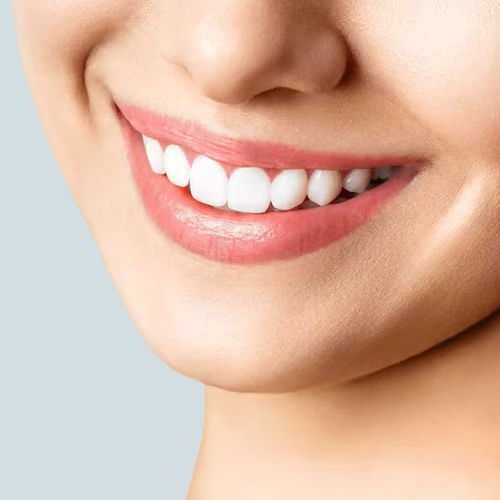
Children smile roughly 400 times per day, while the average adult manages closer to 20. National Smile Day lands on May 31 in part to bridge that gap, drawing attention to what decades of neuroscience research have confirmed: the simple act of smiling triggers measurable changes in brain chemistry, lowering cortisol and releasing dopamine, serotonin, and endorphins.
The observance grew out of a dental practice in suburban Chicago, but its scope extends well beyond oral health. From Guillaume Duchenne's 1862 experiments mapping the muscles of genuine joy to modern studies linking smile intensity with longevity, the science behind a smile has proven far more complex, and far more consequential, than most people realize.
National Smile Day History
The human smile has biological roots stretching back roughly 30 million years. In primates, the expression began as a "fear grin," a display of clenched teeth used to signal submission or harmlessness to dominant group members. Over millennia, that defensive reflex evolved into a social greeting, and in humans it became one of the most universally recognized facial expressions across cultures.
The first scientist to treat the smile as a subject of rigorous anatomy was Guillaume Duchenne de Boulogne. Working in Paris in the 1850s and 1860s, Duchenne applied electrical currents to facial muscles to isolate their individual contributions to expression. His 1862 book, Mecanisme de la Physionomie Humaine, identified two muscles critical to a genuine smile: the zygomatic major, which lifts the corners of the mouth, and the orbicularis oculi, which crinkles the skin around the eyes.
From Anatomy to Emotion
Duchenne's distinction between a full-face smile and a mouth-only grin proved foundational. A decade later, Charles Darwin cited Duchenne's work in The Expression of the Emotions in Man and Animals and proposed that facial movements do not merely reflect emotions but can actively shape them. This idea, later formalized as the facial feedback hypothesis, gained experimental support over the following century.
In 2002, Robert Soussignan published a controlled study showing that participants who produced Duchenne smiles reported more intense positive feelings when exposed to pleasant images. The mechanism involves the release of dopamine, serotonin, and endorphins when the brain detects the activation of smile-related muscles, even if the smile is initially deliberate rather than spontaneous.
A Dental Practice Origins Story
Against this scientific backdrop, Dr. Tim Stirneman and Jim Wojdyla of Compassionate Dental Care in Lake in the Hills, Illinois, launched National Smile Day in 2018. Stirneman, a practicing dentist, and Wojdyla, the practice's director of business development, registered the May 31 observance through the National Day Calendar to spotlight the connection between oral health and overall well-being.
The following year, the practice marked the day by hosting a Dentistry from the Heart event, offering free cleanings, fillings, and extractions to community members without dental insurance. The observance has since been adopted by dental practices and wellness organizations across the United States as an annual prompt to promote both the physical and psychological benefits of a healthy smile.
National Smile Day Timeline
Duchenne maps the genuine smile
Smile intensity linked to lifespan
National Smile Day is founded
National Dental Care Month paired
Free dental care event launched
How to Celebrate National Smile Day
- 1
Schedule a preventive dental checkup
Use the day as a prompt to book a cleaning or exam you have been putting off. The American Dental Association recommends at least one professional cleaning per year to maintain gum health and catch issues early.
- 2
Practice the Duchenne smile exercise
Stand in front of a mirror and lift both the corners of your mouth and your cheek muscles until you feel the skin around your eyes crinkle. Holding this genuine smile for 30 to 60 seconds can engage the facial feedback mechanism and produce a measurable mood lift, even on a stressful day.
- 3
Donate to a free dental care program
Organizations like Dental Lifeline Network connect volunteer dentists with low-income, elderly, and medically vulnerable patients who need care at no cost. A financial contribution or volunteer shift directly helps uninsured patients access the oral care they need.
- 4
Write a note of appreciation to someone
Research on emotional contagion shows that smiles are highly contagious due to mirror neurons that prompt observers to mimic the expression. Send a specific, genuine compliment to a colleague, neighbor, or friend and notice how the exchange shifts both of your moods.
- 5
Read about the science behind your smile
Explore Guillaume Duchenne's groundbreaking research on facial expression in the National Library of Medicine archives. Understanding the difference between a social smile and a Duchenne smile adds a layer of awareness to every interaction.
Why We Love National Smile Day
- A
Smiling activates a measurable neurochemical cascade
When the zygomatic major and orbicularis oculi muscles engage, the brain releases dopamine, serotonin, and endorphins while simultaneously lowering cortisol. This response occurs even with deliberate smiles, giving the facial feedback hypothesis practical applications in stress management and cognitive behavioral therapy.
- B
Oral health barriers affect millions
Roughly 26% of U.S. adults have untreated tooth decay, and dental anxiety keeps an estimated 36% of the population from seeking regular care. National Smile Day directs public attention to preventive dentistry as a gateway to the confidence and social benefits that come with a healthy smile.
- C
Smile perception shapes social outcomes
Studies show that a smile can be recognized from up to 300 feet away, making it the most detectable facial expression at a distance. Research in behavioral psychology has found that people who smile are consistently rated as more trustworthy, approachable, and competent in professional and social evaluations.
Holiday Dates
| Year | Date | Day |
|---|---|---|
| 2023 | Wednesday | |
| 2024 | Friday | |
| 2025 | Saturday | |
| 2026 | Sunday | |
| 2027 | Monday |