April 18
National Velociraptor Awareness Day
An annual observance on April 18 promoting awareness of the Velociraptor, its paleontological significance, and the difference between the real animal and its film depiction.
Unknown
Community Origin
No documented founder or formal establishment record has been identified for National Velociraptor Awareness Day. The observance emerged through internet culture, likely driven by the enduring popularity of the Jurassic Park franchise.

Introduction
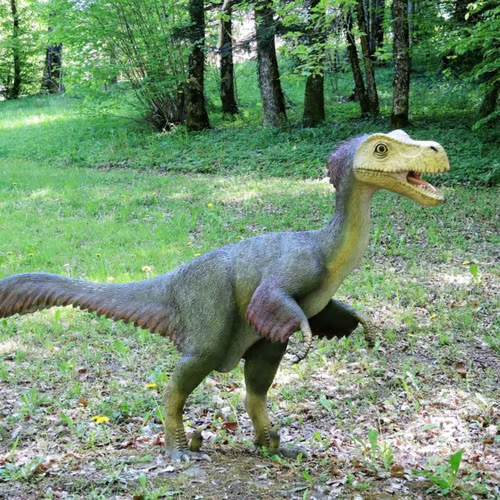
National Velociraptor Awareness Day celebrates one of the most misunderstood animals in popular culture. The Velociraptor that most people picture, a six-foot-tall, scaly predator hunting in packs, never existed. The real Velociraptor mongoliensis was roughly the size of a turkey, weighed about 15 kilograms, and was covered in feathers.
That gap between fiction and fossil record is precisely what makes this observance useful. The real animal, a 75-million-year-old feathered dromaeosaurid discovered in Mongolia's Gobi Desert, is scientifically more interesting than its Hollywood counterpart: its anatomy helped prove that birds evolved from dinosaurs, and one of the most famous fossils in paleontology preserves a Velociraptor locked in combat with another dinosaur at the moment both were buried alive.
National Velociraptor Awareness Day History
The story of the Velociraptor begins in 1923, when the American Museum of Natural History sent an expedition to the Flaming Cliffs (Bayanzag) in Mongolia's Gobi Desert. On August 11, field assistant Peter Kaisen unearthed a crushed but complete skull and an associated toe claw. The following year, AMNH president Henry Fairfield Osborn formally described the specimen and named it Velociraptor mongoliensis, combining the Latin words for "swift" and "plunderer."
The real Velociraptor was a small animal. Adults measured roughly 2 meters from snout to tail, stood about half a meter at the hip, and weighed approximately 15 kilograms. Their most distinctive feature was a large, sickle-shaped claw on the second toe of each foot, which was held retracted off the ground during locomotion and is believed to have been used to pin and restrain struggling prey.
A fossil frozen in combat
On August 3, 1971, a Polish-Mongolian expedition at Tugriken Shire in the Gobi Desert made one of the most remarkable discoveries in paleontological history. The team unearthed a Velociraptor and a Protoceratops preserved in mid-combat, buried alive by what is believed to have been a collapsing sand dune. The Velociraptor's sickle claw was embedded in the Protoceratops' neck region, while the Protoceratops had apparently broken the Velociraptor's arm with its beak. The specimen, known as the "Fighting Dinosaurs," is now a national treasure of Mongolia and provided the first direct fossil evidence of predatory behavior in dromaeosaurids.
The dinosaur renaissance and a naming controversy
The scientific understanding of raptor-type dinosaurs transformed in the 1960s when Yale paleontologist John Ostrom discovered Deinonychus in Montana in 1964. Ostrom's analysis revealed an agile, potentially warm-blooded predator with bird-like skeletal features, overturning decades of thinking about dinosaurs as sluggish, cold-blooded reptiles. His student Robert T. Bakker coined the term "dinosaur renaissance" in 1975 to describe this revolution. In 1988, paleontologist Gregory S. Paul reclassified Deinonychus as a species of Velociraptor in his influential book Predatory Dinosaurs of the World.
When Michael Crichton wrote his 1990 novel Jurassic Park, he used Paul's taxonomy and chose "Velociraptor" over "Deinonychus" because the name sounded "more dramatic." Steven Spielberg's 1993 film adaptation cemented the name in popular culture, but the animals depicted were modeled on the much larger Deinonychus, standing roughly six feet tall. The real Velociraptor was closer to a turkey in size.
Feathers confirmed
The question of whether Velociraptor had feathers was settled in 2007, when paleontologist Alan Turner and colleagues at the American Museum of Natural History identified quill knobs on a Velociraptor forearm fossil excavated in Mongolia in 1998. Quill knobs are the attachment points where feather shafts anchor to bone through ligaments, found in many modern birds. The discovery, published in the journal Science, confirmed that Velociraptor had substantial feathers rather than scales, though it was incapable of flight. The feathers likely served purposes such as display, insulation, or shielding nests.
National Velociraptor Awareness Day Timeline
First Velociraptor fossil discovered
Henry Fairfield Osborn names the genus
Fighting Dinosaurs fossil unearthed
Jurassic Park releases worldwide
Quill knobs prove Velociraptor had feathers
Second Velociraptor species identified
How to Celebrate National Velociraptor Awareness Day
- 1
Compare the real Velociraptor to its film version
The Britannica entry on Velociraptor details the real animal's size, anatomy, and habitat. Use it to identify every difference between the roughly 15-kilogram feathered predator and the six-foot-tall movie version.
- 2
Watch the original Jurassic Park with a fact-check lens
Steven Spielberg's 1993 film made the Velociraptor a household name, but the raptors on screen are modeled on Deinonychus. Watch the kitchen scene and note the animals' size, hands, and skin, then compare each detail to what the fossil record actually shows.
- 3
Explore the AMNH Velociraptor collection online
The American Museum of Natural History houses the original 1923 specimen and maintains an online resource on Velociraptor biology, discovery, and the Gobi Desert expeditions that unearthed it.
- 4
Read the 2007 feather discovery paper
Alan Turner's 2007 paper in Science describes the quill knobs found on a Velociraptor forearm. The finding settled a decades-long debate about whether non-avian dromaeosaurids had true feathers.
- 5
Visit a natural history museum near you
Many natural history museums display Velociraptor casts or dromaeosaurid specimens. Use the American Alliance of Museums directory to locate museums with paleontology exhibits in your area.
Why We Love National Velociraptor Awareness Day
- A
The Velociraptor helped prove birds are dinosaurs
The skeletal similarities between Velociraptor and modern birds, including a wishbone, hollow bones, and the 2007 confirmation of quill knobs for feather attachment, are among the strongest pieces of evidence supporting the dinosaur-bird evolutionary link. Dromaeosaurids like Velociraptor are now classified as close relatives of the lineage that produced all living birds.
- B
It is the most famous case of science vs. Hollywood
The Jurassic Park Velociraptor is roughly four times the size of the real animal, lacks feathers, and hunts in coordinated packs, none of which is supported by the fossil record. The persistent gap between the film version and the real Velociraptor makes it one of paleontology's most effective teaching tools for scientific literacy and critical evaluation of media.
- C
The Fighting Dinosaurs fossil is a unique record of behavior
Fossils almost exclusively preserve anatomy, not behavior. The 1971 Fighting Dinosaurs specimen is one of the only fossils in existence that captures two animals in the act of interacting, providing direct evidence of predation rather than requiring inference from tooth marks or stomach contents.
Holiday Dates
| Year | Date | Day |
|---|---|---|
| 2023 | Tuesday | |
| 2024 | Thursday | |
| 2025 | Friday | |
| 2026 | Saturday | |
| 2027 | Sunday |