
July 23
National Women Touched By Addiction Day
An awareness observance on July 23 recognizing the unique challenges women face with substance use disorders and honoring those in recovery.
Mending Hearts, Inc.
Institutional Initiative
Mending Hearts, Inc., a Nashville-based nonprofit providing long-term residential addiction treatment for women, announced the observance in March 2021 to highlight gender-specific barriers to recovery and reduce stigma around women and addiction.

Introduction
Women develop substance dependence faster than men, a clinical pattern researchers call "telescoping," yet the majority of addiction treatment programs in the United States were designed around male patients. National Women Touched by Addiction Day draws attention to that gap every July 23, centering the biological, social, and institutional forces that shape how women experience addiction and recovery.
The day also extends its scope beyond individual substance use. Mothers grieving a child's overdose, partners managing a spouse's relapse, and friends navigating someone else's crisis are all part of the population this observance is meant to reach. Mending Hearts, the Nashville nonprofit behind the day, has provided residential recovery services to more than 7,500 women since 2004.
National Women Touched by Addiction Day History
Women's relationship with addictive substances in the United States stretches back centuries, shaped by medical practices, social norms, and shifting ideas about who deserves treatment. As early as 1782, opium use among women on Nantucket Island was common enough to draw written notice. Through the 1800s, patent medicines laced with morphine, laudanum, and alcohol were marketed directly to women for ailments ranging from menstrual cramps to anxiety.
By the mid-twentieth century, that medical pattern had intensified. Physicians routinely prescribed tranquilizers and barbiturates to women for stress, insomnia, and mood complaints. By the late 1960s, women made up roughly two-thirds of all psychoactive prescription drug users in the country, a statistic driven more by clinical convention than by patient demand.
Stigma and the Road to Gender-Specific Treatment
Social attitudes compounded the problem. While male substance use was sometimes tolerated or treated as a public health issue, women who used drugs or alcohol faced harsher moral judgment, particularly mothers. By the 1920s, women who used substances were increasingly cast as selfish and unfit, a stigma that discouraged them from seeking help for decades.
The opening of the Betty Ford Center in 1982 marked a turning point. Betty Ford's public disclosure of her own struggles with alcohol and painkillers gave national visibility to female addiction and demonstrated that recovery was possible at any social level. The center's early patient population was majority female, and its model influenced the growth of gender-specific programming across the treatment industry.
From One House to a National Day
In Nashville, Trina Frierson channeled her own recovery from addiction, homelessness, and incarceration into action. In 2004, she opened Mending Hearts with a single house and seven women. The nonprofit grew into a full continuum of care across two campuses, eventually serving more than 7,500 women through residential treatment, medical detox, and outpatient programming.
In March 2021, Mending Hearts announced National Women Touched by Addiction Day, designating July 23 as an annual observance. The day was designed not only for women in recovery but also for those whose families and relationships have been affected by a loved one's addiction, broadening the observance beyond individual substance use to the wider circle of impact.
National Women Touched By Addiction Day Timeline
Early female opium use documented
Women dominate prescription drug use
Betty Ford Center opens
Mending Hearts founded in Nashville
Inaugural observance announced
How to Celebrate National Women Touched By Addiction Day
- 1
Learn about gender-specific recovery programs
Use SAMHSA's treatment locator to explore women-focused programs near you. Understanding what gender-specific care looks like helps you support friends or family members navigating recovery.
- 2
Donate to a women's recovery organization
Nonprofits like Mending Hearts provide long-term residential treatment regardless of a woman's ability to pay. Financial contributions help cover housing, therapy, medical care, and job training for residents.
- 3
Wear purple and share a recovery story
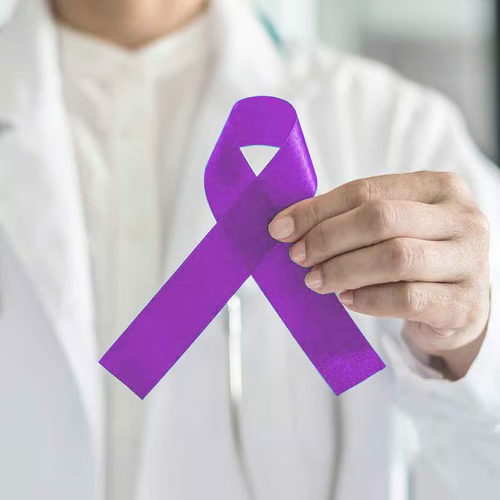
Purple is the designated awareness color for this observance. Sharing verified stories of recovery on social media using the hashtag #WomenTouchedByAddiction helps normalize conversations about women and substance use.
- 4
Read about the science of addiction in women
The National Institute on Drug Abuse publishes a detailed research report on substance use in women covering biological differences, co-occurring disorders, and treatment outcomes. Reading it provides a clinical foundation for understanding why gender matters in addiction treatment.
- 5
Volunteer with a local recovery support group
Contact Faces & Voices of Recovery to find volunteer opportunities at community recovery events. Practical help such as mentoring, meal preparation, or childcare support directly reduces barriers for women attempting to stay in treatment.
Why National Women Touched By Addiction Day is Important
- A
Women develop dependence faster than men
Research documents a phenomenon called 'telescoping,' in which women progress from initial substance use to full dependence more rapidly than men. This accelerated timeline means women often arrive at treatment with more severe medical, psychological, and social complications despite fewer total years of use.
- B
Childcare barriers block treatment access
Fear of losing custody and lack of childcare are among the top reasons women delay or avoid entering addiction treatment. SAMHSA data shows that women are more likely to seek help in primary care or mental health settings rather than specialized addiction programs, partly because those settings do not threaten family separation.
- C
Trauma and addiction intersect at high rates
Studies find that 55 to 99 percent of women in substance abuse treatment report histories of physical or sexual trauma. Women with PTSD are 1.4 times more likely to develop a substance use disorder than women without it, underscoring the need for integrated trauma-informed recovery models.
Holiday Dates
| Year | Date | Day |
|---|---|---|
| 2023 | Sunday | |
| 2024 | Tuesday | |
| 2025 | Wednesday | |
| 2026 | Thursday | |
| 2027 | Friday |