
June 9
Sex Day
An informal U.S. observance on June 9 that promotes discussion of sexual health, intimacy, and education, with its date derived from the 6/9 calendar notation.
Unknown
Unknown
No verified creator has been identified for Sex Day. The observance appears to have emerged on social media in the mid-2010s, with the June 9 date widely understood as a reference to the 69 position suggested by the 6/9 calendar notation.

Introduction
The World Health Organization estimates that more than 1 million curable sexually transmitted infections are acquired every day worldwide, yet public conversations about sexual health remain uncommon in most cultures. Sex Day lands on a date chosen entirely for its innuendo, but the informal observance has become a prompt for the kind of open discussion that public health advocates have pushed for since the early 20th century.
The holiday has no verified founder and no institutional backing. It circulated on social media platforms starting in the mid-2010s, gaining visibility through the same meme culture that turned calendar dates into viral content. What distinguishes it from a simple joke is the way participants have used the day to share sexual health resources, relationship advice, and educational content alongside the humor.
Sex Day History
Public discussion of sexual health in the United States has moved in uneven waves, alternating between institutional advocacy and cultural resistance. The American Sexual Health Association began campaigning for STI testing and classroom sex education in 1914, but broad social stigma kept the subject largely out of mainstream conversation for decades.
The first major shift came from science. Alfred Kinsey's 1948 report on male sexual behavior, followed by his 1953 study of female sexuality, drew on thousands of personal interviews to document a wide gap between what Americans actually did in private and what public morality expected. The Kinsey Reports became bestsellers and are widely credited as precursors to the sexual revolution of the 1960s.
The pill and the sexual revolution
The FDA's 1960 approval of Enovid, the first oral contraceptive, gave women direct control over reproduction for the first time. By 1965, 6 million American women were using the pill. Combined with second-wave feminism and a broader cultural rejection of postwar conservatism, contraception reshaped the social framework around sex, moving it from a strictly procreative context into one that acknowledged pleasure and personal choice.
HIV/AIDS and the education backlash
The emergence of AIDS in 1981 created an urgent public health crisis that forced sexuality back into national discourse, but on starkly different terms. The epidemic strengthened arguments for comprehensive sex education while simultaneously fueling a federal push toward abstinence-only programs that received significant funding through the 1990s and 2000s. The tension between medically accurate education and morality-based approaches continues today.
A holiday from the internet
Sex Day has no documented founder, no proclamation, and no institutional sponsor. The observance appears to have emerged on social media platforms in the mid-2010s, when the meme culture of assigning meaning to calendar dates turned June 9, written as 6/9, into an annual reference to the 69 position. While the date started as humor, participants have increasingly used it to share links to sexual health resources, consent education materials, and relationship guidance.
Sex Day Timeline
ASHA begins sexual health advocacy
Kinsey publishes first sexuality report
FDA approves the first oral contraceptive
First AIDS cases reported in the U.S.
World Sexual Health Day launched
Sex Day emerges on social media
How to Celebrate Sex Day
- 1
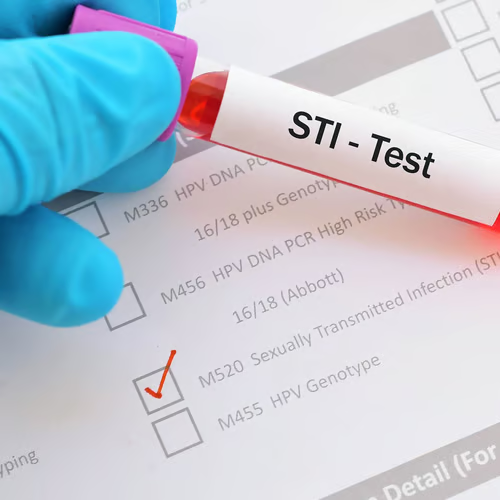
Schedule an STI screening
The CDC recommends sexually active adults get tested at least annually for common infections. Use the CDC's GetTested locator to find free or low-cost testing sites near you.
- 2
Read the WHO's sexual health framework
The World Health Organization's sexual health overview outlines how sexual well-being connects to broader physical and mental health, with links to global data and policy recommendations.
- 3
Have an honest conversation with a partner
Use the day as a prompt to discuss boundaries, preferences, and health status with a current or prospective partner. Research consistently shows that couples who communicate openly about sex report higher relationship satisfaction.
- 4
Explore the Kinsey Institute's resources
Indiana University's Kinsey Institute offers peer-reviewed research on human sexuality, relationships, and sexual health. Their online resources translate academic findings into accessible guides.
- 5
Learn about consent education frameworks
Many universities and advocacy organizations have developed structured consent education programs. Reviewing these frameworks can help clarify the specific language and practices that define informed, enthusiastic consent.
Why Sex Day is Important
- A
Sexual health remains underdiscussed despite global impact
More than 1 million curable sexually transmitted infections are acquired daily worldwide among people aged 15 to 49, according to the World Health Organization. Despite this scale, sexual health conversations remain stigmatized in most cultures, limiting access to prevention and treatment information.
- B
The WHO defines sexual health as more than disease prevention
The World Health Organization's definition, first adopted in 1974, describes sexual health as 'a state of physical, emotional, mental and social well-being in relation to sexuality,' explicitly noting that it is not merely the absence of disease. That framing positions sexual well-being as a component of overall health rather than a separate medical category.
- C
Informal observances reach audiences formal campaigns miss
Sex Day's origin in meme culture gives it a viral reach that institutional health campaigns often struggle to achieve. Social media posts tagged with the date routinely include links to STI testing resources, consent education, and relationship advice, embedding public health messaging in entertainment content.
Holiday Dates
| Year | Date | Day |
|---|---|---|
| 2023 | Friday | |
| 2024 | Sunday | |
| 2025 | Monday | |
| 2026 | Tuesday | |
| 2027 | Wednesday |