August 1
Spider-Man Day
A pop culture observance on August 1 celebrating Spider-Man, the Marvel Comics superhero, and his enduring influence on comics, film, and global entertainment.
Unknown
Community Origin
No verified creator has been identified for Spider-Man Day. The August 1 date corresponds to the cover date of Amazing Fantasy #15 (August 1962), the comic in which Spider-Man first appeared. The observance emerged organically among fans and on social media.

Introduction
Spider-Man first appeared in Amazing Fantasy #15 in August 1962, a comic that was supposed to be the final issue of its series. Instead, the overwhelming reader response to a teenage superhero who worried about homework and rent money launched what would become one of the most valuable entertainment franchises in history: 10 films grossing approximately $9 billion, video games generating billions more, and a character recognized worldwide alongside Batman and Superman.
Spider-Man Day falls on August 1, the cover date of that first appearance. The observance has no official founder but has grown steadily through fan communities that treat the date as an annual celebration of the character Stan Lee and Steve Ditko created in a medium many adults dismissed as disposable.
Spider-Man Day History
Stan Lee wanted to create a superhero who was a teenager, not a sidekick. In 1962, that idea ran against every convention in comics. Teen characters like Bucky Barnes and Robin existed to support adult heroes, not carry their own stories. Lee initially asked Jack Kirby to draw the character, but Kirby's designs looked too powerful and confident. Lee turned instead to Steve Ditko, whose thin, angular style captured the awkwardness Lee envisioned for Peter Parker.
A last issue becomes a first chapter
Amazing Fantasy #15, published with an August 1962 cover date, was supposed to be the final issue of a struggling anthology series. The Spider-Man story occupied 11 pages. Parker, a science-obsessed high school student, is bitten by a radioactive spider and gains superhuman strength, agility, and a precognitive "spider-sense." After initially using his powers for personal gain, he learns the cost of selfishness when his inaction leads to his Uncle Ben's death, crystallizing the principle: "With great power comes great responsibility."
Reader mail overwhelmed Marvel's offices. Within months, Spider-Man had his own ongoing series. The Amazing Spider-Man launched in March 1963 and would run continuously for over five decades.
Ditko's design makes the character universal
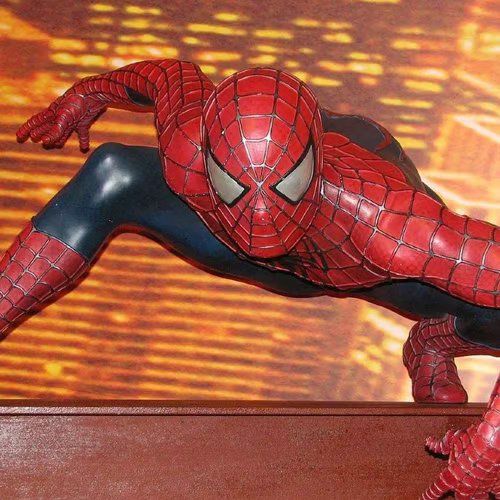
Ditko's full-body costume was a deliberate creative choice. Unlike Superman or Captain America, whose faces were visible, Spider-Man's mask covered every feature. Lee later said this allowed anyone to see themselves behind the mask, regardless of race, age, or background. The design became one of the most recognizable images in popular culture, reproduced on merchandise generating billions in annual licensing revenue.
From page to screen to global franchise
Sam Raimi's 2002 film starring Tobey Maguire grossed over $810 million and established the superhero film as a dominant box-office category. Two subsequent film series followed: Andrew Garfield's The Amazing Spider-Man (2012-2014) and Tom Holland's integration into the Marvel Cinematic Universe starting in 2016. By 2021, Spider-Man: No Way Home brought all three actors together and earned nearly $2 billion worldwide.
The animated Spider-Man: Into the Spider-Verse (2018) won the Academy Award for Best Animated Feature, while Insomniac Games' Marvel's Spider-Man (2018) became one of the best-selling PlayStation exclusives, praised for capturing the sensation of web-swinging through a virtual New York City.
Spider-Man Day Timeline
Spider-Man debuts in Amazing Fantasy #15
The Amazing Spider-Man series launches
Sam Raimi's Spider-Man redefines superhero film
Marvel's Spider-Man video game sets new standard
Into the Spider-Verse wins the Academy Award
No Way Home earns nearly $2 billion
How to Celebrate Spider-Man Day
- 1
Read where it all started
Amazing Fantasy #15 is available digitally through Marvel's comic platform. Reading the original 11-page story reveals how much of Spider-Man's identity was established in a single issue.
- 2
Watch a Spider-Man film from a different era
Each Spider-Man film series reflects a different period of superhero filmmaking. Comparing Raimi's 2002 original with Into the Spider-Verse (2018) or No Way Home (2021) shows how the character adapts to evolving audiences and storytelling styles.
- 3
Explore the real New York locations
Spider-Man's New York is based on real landmarks: the Flatiron Building, the Queensboro Bridge, Forest Hills in Queens where Peter Parker grew up. The NYC tourism site can help plan a route through the character's fictional neighborhood.
- 4
Learn about Steve Ditko's artistic legacy
Ditko, who died in 2018, rarely gave interviews and refused to attend conventions. His design philosophy prioritized visual storytelling over flash. The Comic Art Fans archive preserves original art from his era.
- 5
Introduce someone to the character for the first time
Spider-Man's accessibility is part of his appeal. Into the Spider-Verse is widely considered one of the best animated films ever made, and the Marvel's Spider-Man video game offers an interactive entry point for non-readers.
Why We Love Spider-Man Day
- A
Spider-Man changed who superheroes could be
Before Spider-Man, superheroes were adults with extraordinary confidence. Peter Parker was a teenager dealing with bullying, financial stress, and self-doubt while trying to do the right thing. That template, the flawed hero defined by responsibility rather than perfection, influenced virtually every superhero created after 1962.
- B
The franchise is one of entertainment's most valuable properties
The Spider-Man film franchise has generated approximately $9 billion across 10 films. Spider-Man: No Way Home alone earned nearly $2 billion. A near-mint copy of Amazing Fantasy #15 sold at auction for $3.6 million in 2021, reflecting the character's cultural and collector value.
- C
The character continues to evolve across media and identities
Miles Morales, introduced in 2011 as an Afro-Latino Spider-Man, expanded the character's reach and representation. Into the Spider-Verse and its sequel explored the idea that anyone can wear the mask, a theme embedded in Ditko's original faceless costume design.
Holiday Dates
| Year | Date | Day |
|---|---|---|
| 2023 | Tuesday | |
| 2024 | Thursday | |
| 2025 | Friday | |
| 2026 | Saturday | |
| 2027 | Sunday |