March 31
Transfer Day
A heritage observance on March 31 commemorating the transfer of the U.S. Virgin Islands from Danish to American rule in 1917.
Governments of Denmark and the United States
Government Proclamation
Transfer Day commemorates the formal transfer ceremony on March 31, 1917, when Denmark sold the Danish West Indies to the United States for $25 million in gold. It became a public holiday in the U.S. Virgin Islands via territorial law.

Introduction
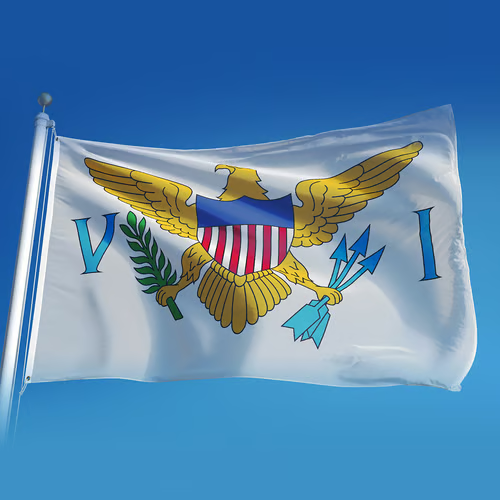
On the morning of March 31, 1917, the Danish flag came down over the islands of St. Thomas, St. John, and St. Croix for the last time. In its place rose the Stars and Stripes, and a 250-year chapter of Danish colonial rule ended with a handshake, a check for $25 million in gold, and a ceremony that gave the islands' residents a new nationality they had never voted on.
Transfer Day marks that exchange of sovereignty. It is both a public holiday in the U.S. Virgin Islands and a reminder that the territory's path to self-governance is still unfinished more than a century later.
Transfer Day History
Denmark claimed St. Thomas in 1672 and added St. John in 1718. St. Croix came later, purchased from France in 1733. For two centuries, the Danish West Indies operated as a plantation colony where enslaved Africans produced sugar, cotton, and rum for European markets.
That economy collapsed after Denmark abolished slavery in the colony in 1848. Freed laborers demanded wages the planters could not afford, and competition from sugar beet producers in Europe undercut Caribbean cane sugar. By the late 1800s, the Danish government was subsidizing a colony that could no longer sustain itself.
Decades of Failed Deals
The United States first tried to buy the islands in 1867, when Secretary of State William Seward offered $7.5 million. Danish voters in the islands approved the sale, but the U.S. Senate refused to ratify the treaty. A second attempt in 1902 passed the Danish parliament's lower house but failed in the upper chamber by a single vote.
World War I Forces the Sale
The outbreak of World War I changed the calculus entirely. American military planners feared that if Germany invaded Denmark, it could seize the islands and use them as submarine bases threatening the Panama Canal. The sinking of the Lusitania in 1915 sharpened the urgency.
Negotiations moved quickly after that. Denmark and the United States signed a cession treaty on August 4, 1916. Danish voters approved the sale in a national referendum that December, and ratifications were exchanged on January 17, 1917.
The Transfer Ceremony
On March 31, 1917, the formal transfer took place. The United States paid $25 million in gold and, as part of the agreement, recognized Denmark's sovereignty over Greenland. The islands' roughly 26,000 residents were given "American nationality" but not full U.S. citizenship.
The U.S. Navy governed the territory until 1931, when administration passed to the Department of the Interior. Congress extended citizenship to most residents in 1927. The right to elect their own governor did not arrive until 1970, more than half a century after the flag was raised.
Transfer Day Timeline
First U.S. purchase attempt fails
Transfer ceremony takes place
U.S. citizenship granted
Organic Act signed into law
First elected governor takes office
How to Celebrate Transfer Day
- 1
Attend a Transfer Day ceremony on the islands
Local governments in St. Thomas, St. John, and St. Croix host annual Transfer Day events including flag ceremonies, reenactments, and public speeches. The U.S. Virgin Islands tourism board publishes event schedules each year.
- 2
Read the original cession treaty
The full text of the 1916 Convention between the United States and Denmark is available through the Avalon Project at Yale Law School. Reading the treaty's 12 articles shows what the original terms actually said about citizenship, property rights, and religious freedom.
- 3
Explore the islands' Danish architectural heritage
Buildings like Fort Christian, completed in 1680 and the oldest standing structure in the territory, reflect two and a half centuries of Danish civic planning. Virtual and in-person tours are available through local historical societies.
- 4
Cook a traditional Virgin Islands dish
Prepare kallaloo, a thick soup of leafy greens, okra, and salted meat that blends African, Danish, and Caribbean culinary traditions. The dish connects directly to the agricultural and cultural history the holiday commemorates.
- 5
Study the territory's ongoing status debate
The Department of the Interior's Office of Insular Affairs provides background on the territory's political status and constitutional conventions. Understanding where the islands stand today adds depth to what the holiday represents.
Why Transfer Day is Important
- A
It documents an unfinished path to self-governance
Virgin Islanders gained citizenship in stages over 15 years, and the right to elect their own governor took until 1970. The territory still lacks voting representation in Congress and full constitutional autonomy, making Transfer Day a live civic question rather than settled history.
- B
It records the last major U.S. territorial purchase
The 1917 acquisition was one of the final additions of permanently inhabited territory to the United States. The deal's terms shaped subsequent U.S. policy on territorial governance and citizenship for insular possessions, setting precedents still debated today.
- C
It preserves Danish colonial memory in the Caribbean
The Danish West Indies were Denmark's only Caribbean colony, and the transfer ended 250 years of Danish presence in the region. Transfer Day ceremonies maintain a cultural bridge between the islands and Denmark, including periodic visits by Danish officials.
Holiday Dates
| Year | Date | Day |
|---|---|---|
| 2023 | Friday | |
| 2024 | Sunday | |
| 2025 | Monday | |
| 2026 | Tuesday | |
| 2027 | Wednesday |