October 11
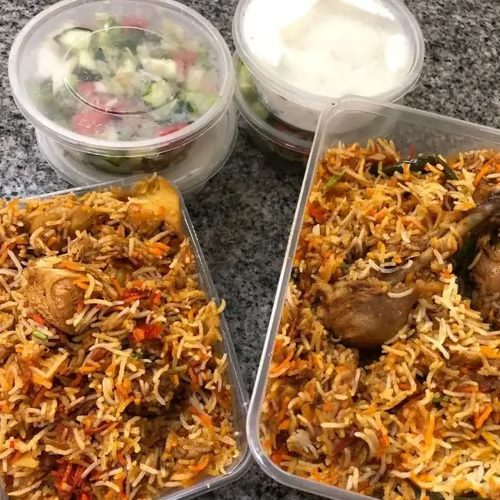
World Biryani Day
A food observance on October 11 celebrating biryani, the layered rice dish rooted in Persian and Mughal culinary traditions, and its diverse regional variations worldwide.
Unknown
Community Origin
No documented founder or formal establishment record has been identified for the October 11 observance of World Biryani Day. The date circulates on holiday calendar sites without traceable primary evidence of who created it or when it began.

Introduction
World Biryani Day puts a spotlight on a dish whose name reveals its technique. The word "biryani" comes from the Persian "birian," meaning "fried before cooking," a reference to the method of searing rice in fat before layering it with spiced meat and slow-cooking the whole assembly under a sealed lid.
That technique, refined across centuries in royal kitchens from Persia to the Indian subcontinent, produced a dish that Indians ordered 93 million times through a single delivery platform in 2025. Biryani is not simply popular; it is, by order volume, the most consumed prepared dish in the world's most populous country.
World Biryani Day History
The dish that eventually became biryani has roots older than the name itself. Tamil literature from as early as 2 AD describes "Oon Soru," a preparation of rice cooked with ghee, meat, turmeric, and pepper, served to soldiers in southern India. On the subcontinent's opposite flank, Persian cooks had long practiced layering rice with saffron and slow-cooked meat.
The two traditions collided when Mughal rulers established their empire across northern India beginning in the 1500s. Royal kitchens blended Persian "dum" cooking, sealing a pot with dough and letting steam do the work, with the Indian subcontinent's arsenal of spices.
Regional Styles and Royal Kitchens
The biryani that emerged from Mughal courts was not a single recipe but a framework. In Hyderabad, the kitchens of the Nizams developed the "kacchi dum" method: raw marinated meat layered with partially cooked rice, sealed, and slow-cooked together so the meat juices permeate the grain from below. The result is intensely flavored, heavy on saffron and fried onions.
In Lucknow, the Nawabs of Awadh took a different approach. Their "pakki" method calls for pre-cooking the meat in a rich yakhni (bone broth) before layering it with rice. Lucknowi biryani is deliberately subtle, perfumed with rose water and kewra (screwpine) essence rather than chili heat.
The Kolkata Variation
Kolkata's biryani exists because of a political catastrophe. In 1856, the British East India Company deposed Nawab Wajid Ali Shah, the last ruler of Awadh, and exiled him to Calcutta. His cooks came with him but faced tight budgets. They stretched each pot by adding potatoes and boiled eggs, substituting cheaper ingredients for some of the meat. That improvisation became Kolkata biryani's defining feature.
A Dish Without a Documented Holiday Origin
No documented founder or formal establishment record exists for World Biryani Day as observed on October 11. The date appears on holiday calendar sites without traceable evidence of who created it or when it began. A separate corporate-backed observance, launched by the rice brand Daawat (LT Foods) in 2022, falls on the first Sunday in July, but it is a distinct event with a different date.
World Biryani Day Timeline
Tamil rice-and-meat dish documented
Timur brings rice dish to India
Mughal kitchens refine biryani
Kolkata biryani emerges from exile
India orders 93 million biryanis
How to Celebrate World Biryani Day
- 1
Cook a biryani using the dum method
The traditional dum technique requires sealing a pot with dough to trap steam while layered rice and meat cook together. The Britannica biryani entry provides cultural context on the dum process and its origins in Persian and Mughal-era cooking.
- 2
Compare regional biryani styles
Order or prepare Hyderabadi, Lucknowi, and Kolkata biryanis side by side to taste the differences in spice intensity, aromatics, and ingredients. Hyderabad's version is boldly spiced with saffron and fried onions, Lucknow's uses rose water and bone broth, and Kolkata's adds potatoes and boiled eggs.
- 3
Visit a South Asian restaurant or market
Many Indian and Pakistani restaurants prepare biryani fresh for the lunch rush using large handis (wide-mouthed cooking pots). Dining in lets you experience the dish at its best, served immediately after the seal is broken and the steam released.
- 4
Research the Mughal food history behind biryani
The biryani entry on Wikipedia provides an accessible starting point covering Persian origins, Mughal refinement, and the development of over 50 documented regional variants across the Indian subcontinent.
- 5
Explore the spices that define the dish
Biryani's flavor depends on specific aromatics: saffron, green cardamom, mace, bay leaves, and star anise. The Spices Board of India, a government body, publishes guides on sourcing, grading, and using these ingredients.
Why We Love World Biryani Day
- A
It tracks the scale of India's food economy
In 2025, Indians ordered 93 million biryanis through Swiggy alone, roughly 194 plates per minute. Hyderabad led all cities with 9.7 million orders, followed by Bengaluru at 7.7 million and Chennai at 4.6 million.
- B
It documents culinary fusion across empires
Biryani is a direct product of Persian cooking methods meeting Indian spice traditions inside Mughal royal kitchens. Each regional variant, from Hyderabad's kacchi dum to Lucknow's pakki method, records a specific court's preferences and available ingredients.
- C
It maps the global South Asian diaspora
Biryani's spread to London, New York, Dubai, and Toronto tracks directly with South Asian migration patterns. The dish functions as a cultural anchor for diaspora communities, consistently ranking among the most ordered items on food delivery platforms in multiple countries.
Holiday Dates
| Year | Date | Day |
|---|---|---|
| 2023 | Wednesday | |
| 2024 | Friday | |
| 2025 | Saturday | |
| 2026 | Sunday | |
| 2027 | Monday |