
April 15
National Anime Day
An annual observance on April 15 celebrating Japanese animation (anime) as an art form, its global cultural influence, and the worldwide community of fans who consume and create it.
Unknown
Community Origin
National Anime Day is widely attributed to the anime retailer AnimeUSA, which reportedly inaugurated the observance in 2006. However, no formal institutional record confirms this. The April 15 date has been linked to both the founding of AnimeUSA and to the 1917 release of Namakura Gatana, one of the earliest surviving Japanese animated films.

Introduction
National Anime Day celebrates an art form that grew from a single Tokyo studio's experiment in limited animation into a $21 billion global industry. In 2023, for the first time in history, overseas revenue from anime surpassed domestic Japanese revenue, a milestone that confirmed what fans have known for decades: anime is no longer a niche Japanese export but a dominant force in global entertainment.
The medium's influence extends far beyond its own genre. Western animation, film, fashion, and video game design have all absorbed anime's visual language: the expressive eyes, the kinetic action sequences, the willingness to treat animated storytelling as a vehicle for adult themes. National Anime Day is an opportunity to trace how that influence spread.
National Anime Day History
Japanese animation traces its roots to the early 20th century, when artists began experimenting with the medium alongside similar developments in Europe and the United States. The oldest surviving Japanese animated work, Namakura Gatana (The Dull Sword), was released in 1917 as a two-minute silent short about a samurai who buys a sword that turns out to be worthless. Animators like Oten Shimokawa, Jun'ichi Kouchi, and Seitaro Kitayama worked independently during this period, producing short films influenced by both Western animation techniques and traditional Japanese art.
The medium remained a relatively small craft industry through the pre-war and wartime periods. The Japanese military commissioned propaganda animations during World War II, and feature-length animated films like Momotaro: Sacred Sailors (1945) appeared, but the modern anime industry did not take shape until one person revolutionized the form.
Osamu Tezuka and the birth of TV anime
Osamu Tezuka, a manga artist who had trained as a physician, founded Mushi Production in 1962 and produced Astro Boy (Mighty Atom) as the first popular animated Japanese television series in 1963. Tezuka's innovations defined the medium: he developed limited animation techniques that made weekly TV production economically viable, and his character designs, featuring large expressive eyes influenced by Disney's Bambi, became the visual signature of anime. Astro Boy was also the first anime exported to Western markets, airing on NBC in the United States.
Global breakthrough
Anime remained primarily a domestic Japanese industry until the 1980s and 1990s, when a series of works broke through to international audiences. Akira (1988) demonstrated feature-film quality animation and adult-oriented storytelling. Dragon Ball Z, Sailor Moon, and Pokémon brought anime to mainstream Western television in the 1990s. In 2003, Hayao Miyazaki's Spirited Away won the Academy Award for Best Animated Feature, the first hand-drawn and non-English-language animated film to receive the honor.
The streaming era
The arrival of streaming platforms transformed anime from a collector's hobby into an on-demand global product. By 2023, the global anime industry reached 3.35 trillion yen (approximately $21 billion), its all-time high. For the first time, overseas revenue surpassed domestic Japanese revenue, with international sources generating 1.72 trillion yen compared to 1.62 trillion yen domestically. National Anime Day, attributed to the retailer AnimeUSA in 2006, arrived at the beginning of this global expansion.
National Anime Day Timeline
Earliest surviving anime film released
Astro Boy premieres on television
Comiket holds its first event
Akira redefines anime for Western audiences
Spirited Away wins the Academy Award
National Anime Day first observed
How to Celebrate National Anime Day
- 1
Watch a landmark anime film
Start with one of the works that changed the medium: Spirited Away (2001), Akira (1988), or Your Name (2016). Each represents a different era and style of Japanese animation.
- 2
Explore the history of anime online
The Britannica entry on anime provides a solid overview of the medium's evolution from early 20th-century experiments to the streaming-era global industry.
- 3
Read a manga that inspired an anime
Many of the most famous anime series began as manga. Pick up the source material for a series you have watched and compare the two formats. Osamu Tezuka's original Astro Boy manga is a good starting point.
- 4
Attend or explore a convention online
Anime conventions like Anime Expo, Otakon, and Comiket bring together fans, creators, and industry professionals. Even if you cannot attend in person, many conventions livestream panels and post recordings online.
- 5
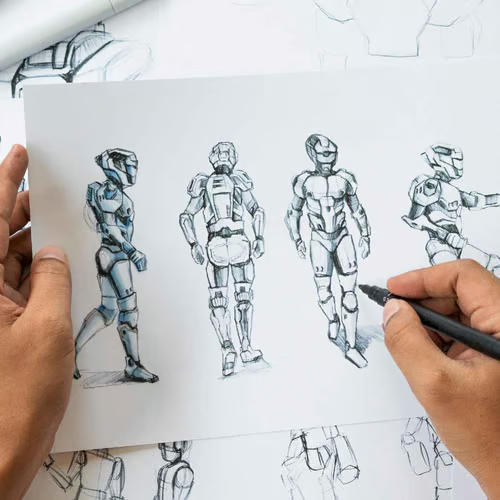
Try drawing in the anime style
Anime's visual style, particularly the large expressive eyes and dynamic poses, has specific techniques that can be learned. Spend an hour sketching characters and studying how professional animators convey emotion through simplified but highly expressive designs.
Why We Love National Anime Day
- A
Anime is a $21 billion industry that now earns more abroad than at home
In 2023, the global anime industry hit 3.35 trillion yen, with overseas revenue exceeding domestic Japanese revenue for the first time. The market is projected to reach $66-77 billion by the early 2030s. This is not a subculture: it is one of Japan's most significant cultural exports.
- B
It proved that animation can tell any story
Anime shattered the Western assumption that animation is primarily for children. Works like Akira, Ghost in the Shell, and Attack on Titan use the medium to explore war, identity, philosophy, and political corruption with a depth and ambiguity that live-action productions often avoid.
- C
It reshaped global visual culture
Anime's visual language, from expressive character design to dynamic action choreography, has influenced Western animation (Avatar: The Last Airbender), film (The Matrix), video games, and fashion. Osamu Tezuka's decision to give characters large, emotive eyes in 1963 created a design standard that now appears across media worldwide.
Holiday Dates
| Year | Date | Day |
|---|---|---|
| 2023 | Saturday | |
| 2024 | Monday | |
| 2025 | Tuesday | |
| 2026 | Wednesday | |
| 2027 | Thursday |