August 5
National Underwear Day
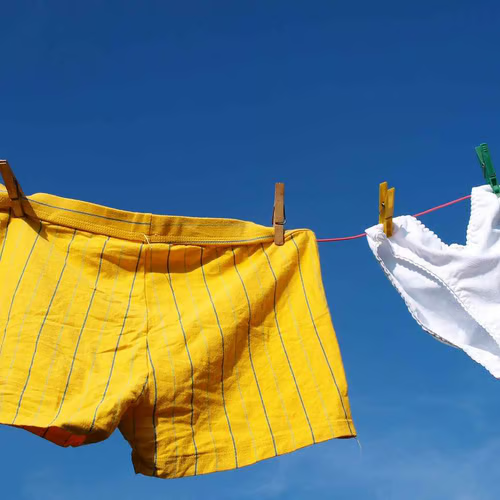
A lighthearted observance on August 5 celebrating underwear as a foundational garment and promoting body confidence and self-expression.
Freshpair
Corporate Initiative
Freshpair, an online underwear retailer, established National Underwear Day in 2003 to promote body positivity and draw attention to underwear as a garment category. The company held annual events in New York City including a Times Square runway show and a 2013 attempt at a Guinness World Record.

Introduction
The global underwear market was valued at approximately $90 billion in 2023 and is projected to reach $140 billion by 2032. That figure covers a garment most people think about only when choosing one in the morning or replacing one that has worn out. Underwear is the most universal piece of clothing on the planet, worn across every culture and climate, yet it receives far less attention than any outer garment.
National Underwear Day exists to address that gap. The observance started as a promotional event by an online retailer but has grown into a broader celebration of body confidence and the surprisingly deep history of the garment closest to skin. Underwear has been shaped by technology, social norms, gender politics, and material science for over 7,000 years, and its evolution mirrors larger shifts in how societies think about the human body.
National Underwear Day Deals
1 Brand Historically Offered Deals

National Underwear Day History
National Underwear Day celebrates one of the few garments that virtually every person wears but rarely thinks about historically. The evolution from animal-hide loincloths to a $90 billion global industry tracks closely with broader shifts in technology, manufacturing, gender norms, and body culture.
The loincloth is the oldest known garment of any kind. Archaeological evidence places its use at over 7,000 years ago, made from animal hides, bark, or woven plant fibers. By 3000 BCE, the Egyptians had formalized the concept with the schenti, a linen loincloth whose length and quality indicated the wearer's social rank. Roman athletes and laborers wore the subligaculum, a wrapped undergarment secured at the waist.
Medieval underwear and the question of women's underpants
In medieval Europe, men wore braies — loose linen trousers that extended to the knee or ankle and were tied at the waist. As outer clothing evolved, braies shortened and became recognizable undergarments. Women wore the chemise or shift, a loose linen garment worn directly against the skin. The chemise served a practical function: it was washed frequently while outer garments, which were expensive and difficult to clean, were not.
One of the most surprising facts in clothing history is that European women generally did not wear separate underpants until the 19th century. The chemise alone served as their undergarment. Drawers for women emerged in the early 1800s and remained controversial for decades, as they were associated with men's clothing.
Industrialization transforms undergarments
The spinning jenny (1764), power loom (1785), and sewing machine (1851) made mass production of textiles practical for the first time. Underwear, previously sewn at home or by tailors, became a manufactured product. The union suit — a one-piece undergarment covering the torso and legs — dominated the late 19th and early 20th centuries.
The modern bra emerged in 1914 when Mary Phelps Jacob patented a design made from handkerchiefs and ribbon, offering an alternative to the corset. Coopers Inc. (now Jockey) introduced the first Y-front briefs in 1935, giving men a supportive alternative to boxers. Boxer shorts, modeled after the garments worn by prizefighters, had appeared in the 1920s.
Synthetic fibers and the modern era
DuPont's introduction of nylon (1938) and Lycra spandex (1959) transformed underwear from a utilitarian necessity into a product defined by comfort, fit, and fashion. Rudi Gernreich popularized the thong in 1974. Boxer briefs, combining the coverage of boxers with the fit of briefs, arrived in the 1990s. Today, the global underwear market is valued at approximately $90 billion, with the sustainable underwear segment alone reaching $1.8 billion as consumers demand organic cotton, bamboo, and recycled fabrics. National Underwear Day, launched in 2003, arrived just as the industry was transforming underwear from a private necessity into a public statement of identity and self-expression.
National Underwear Day Timeline
The loincloth appears as the first underwear
Mary Phelps Jacob patents the modern bra
Coopers Inc. sells the first Y-front briefs
DuPont introduces Lycra spandex
Freshpair establishes National Underwear Day
800 people gather in underwear in Times Square
How to Celebrate National Underwear Day
- 1
Replace underwear past its useful life
Most underwear should be replaced every 6-12 months depending on wear. National Underwear Day is a practical reminder to evaluate what is in the drawer and discard garments that have lost elasticity, shape, or hygiene.
- 2
Explore the history of fashion and undergarments
The Victoria and Albert Museum's fashion collection documents the evolution of clothing from corsets and chemises to modern underwear, placing intimate garments in their cultural and social context.
- 3
Explore the history of fashion undergarments
The Metropolitan Museum of Art's Heilbrunn Timeline includes entries on undergarments and fashion history, placing corsets, chemises, and modern underwear in their cultural context.
- 4
Support a sustainable underwear brand
The sustainable underwear market is growing rapidly as brands adopt organic cotton, bamboo fiber, and recycled materials. Choosing sustainably produced underwear reduces environmental impact while supporting responsible manufacturing.
- 5
Donate new underwear to a shelter
Underwear is the most requested and least donated item at homeless shelters. Bombas has donated over 100 million clothing items to people experiencing homelessness, with underwear as a core focus of their giving model.
Why We Love National Underwear Day
- A
Underwear reflects how societies think about bodies
Every shift in underwear design — from the corset to the bra, from the codpiece to the brief — mirrors a change in how a society views modesty, gender, sexuality, and the human form. The garment closest to skin reveals more about cultural values than any visible piece of clothing.
- B
The industry is a major economic force
The global underwear market was valued at approximately $90 billion in 2023 and is projected to reach $140 billion by 2032. The sector drives innovation in textile technology, sustainable manufacturing, and supply chain logistics.
- C
Body positivity has reshaped the category
The body positivity movement has pushed underwear brands to expand size ranges, feature diverse models, offer gender-neutral designs, and develop 'nude' shades that match a range of skin tones. These changes reflect a broader shift away from a single body ideal toward inclusive representation.
Holiday Dates
| Year | Date | Day |
|---|---|---|
| 2023 | Saturday | |
| 2024 | Monday | |
| 2025 | Tuesday | |
| 2026 | Wednesday | |
| 2027 | Thursday |