April 9
National Unicorn Day
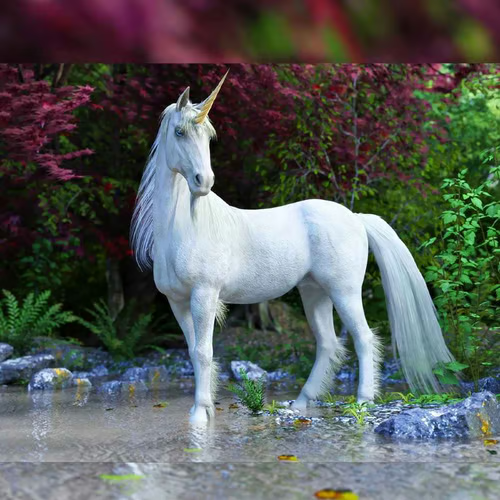
An annual observance on April 9 celebrating the unicorn as a cultural and mythological symbol, drawing on traditions spanning from ancient Greek texts to modern popular culture.
Unknown
Community Origin
No verified founder has been identified for National Unicorn Day. The observance first appeared on online holiday calendar sites around 2015 and quickly gained traction through social media.

Introduction
National Unicorn Day celebrates a creature that has never existed and yet has never stopped mattering. The unicorn appears in the recorded mythology of nearly every major civilization: Greek physicians wrote clinical descriptions of it, medieval merchants sold its horn for more than gold, and one European nation chose it as its official national animal over every real species available.
That nation is Scotland, which adopted the unicorn as its heraldic symbol in the 12th century and has never replaced it. The choice was not whimsical. In Celtic mythology, the unicorn represented power that could not be tamed, making it a deliberate political statement. The fact that the creature is imaginary was beside the point.
National Unicorn Day History
The unicorn's written history begins not with fairy tales but with natural history. Around 400 BCE, Greek physician Ctesias published Indica, a treatise on India compiled from travelers' accounts. He described a wild ass the size of a horse, with a white body, a dark red head, blue eyes, and a single horn about 18 inches long, colored white at the base, black in the middle, and red at the tip. Ctesias wrote as a scientist, not a storyteller. He believed the animal was real.
Later Greek and Roman writers built on his account. Aristotle mentioned one-horned animals in his zoological writings. Pliny the Elder described a creature with the body of a horse, the head of a stag, the feet of an elephant, and a single black horn three feet long. None of these authors treated the unicorn as mythical. For centuries, the one-horned animal occupied the same category as the elephant or rhinoceros: foreign, exotic, and believed to exist somewhere beyond the known world.
The medieval horn trade
The unicorn's cultural power reached its peak in medieval Europe, where the creature became associated with purity, grace, and Christ. Medieval bestiaries taught that unicorns could only be captured by a virgin, and their horns were believed to purify poisoned water and cure illness. This created enormous demand for "unicorn horn," which merchants happily supplied using narwhal tusks. Arctic traders sold narwhal ivory to European courts at prices exceeding gold by weight, and the deception persisted for centuries. Queen Elizabeth I owned a narwhal tusk valued at £10,000 in the 1500s, the price of a castle.
Heraldry and national identity
Scotland's adoption of the unicorn as its national animal in the 12th century gave the creature a political dimension. In Celtic tradition, the unicorn represented an untameable spirit, making it an ideal symbol for a kingdom that resisted English conquest. When James VI of Scotland became James I of England in 1603, uniting the two crowns, the Scottish unicorn was placed opposite the English lion on the Royal Coat of Arms. The pairing was deliberately symbolic: the two animals were traditional enemies in heraldic tradition, and the tension between them represented the uneasy union of the kingdoms.
Modern revival
The unicorn's cultural status surged again in the 2010s, driven by social media, products, and pop culture. National Unicorn Day appeared on online holiday calendars around 2015. No verified founder has been identified. The holiday arrived during a period when unicorn-themed food, fashion, and merchandise became a billion-dollar commercial category, but the mythological roots that give the symbol its staying power are ancient and deeply embedded in Western culture.
National Unicorn Day Timeline
Ctesias describes a one-horned animal
Scotland adopts the unicorn
The Unicorn Tapestries are woven
Lion meets unicorn on the Royal Coat of Arms
National Unicorn Day first observed
How to Celebrate National Unicorn Day
- 1
Visit The Cloisters' Unicorn Tapestries
The seven Unicorn Tapestries at The Cloisters in New York are among the most famous works of medieval art in the world. If you cannot visit in person, the Metropolitan Museum offers high-resolution images and scholarly commentary online.
- 2
Read up on the real animal behind the myth
The narwhal, a whale with a single spiraling tusk up to 10 feet long, is the closest real-world analog to the unicorn. National Geographic's narwhal profile explains the biology behind the tusk and why it fueled centuries of unicorn belief.
- 3
Explore Scotland's unicorn heraldry
The National Trust for Scotland explains why Scotland chose a mythical creature as its national animal and how the unicorn appears in Scottish architecture, monuments, and royal insignia.
- 4
Read Ctesias' original description
Track down a translation of Ctesias' Indica, the oldest known Western description of a unicorn-like animal. The clinical, matter-of-fact tone is surprising: this was not a fairy tale but what passed for zoology in 400 BCE.
- 5
Host a unicorn-themed craft session
Especially for kids, National Unicorn Day is an opportunity to explore mythology through art. Draw, paint, or build unicorns while discussing where the stories came from and why cultures around the world invented similar creatures independently.
Why We Love National Unicorn Day
- A
The unicorn reveals how mythology becomes natural history
For over a thousand years, the unicorn was not considered mythical. Greek physicians, Roman naturalists, and medieval scholars all believed it was a real animal living in unexplored regions. The unicorn's story is a case study in how cultures construct knowledge about the natural world from incomplete evidence.
- B
Scotland chose it as a national animal for a reason
Scotland is the only country in the world whose national animal is a mythical creature. The choice dates to the 12th century and reflects Celtic values of independence and untameability. The heraldic unicorn remains on British currency, passports, and official documents to this day.
- C
The narwhal tusk trade shaped medieval economics
The sale of narwhal tusks as unicorn horns was one of the most profitable deceptions in medieval commerce. Tusks were sold to royalty, cathedrals, and apothecaries at prices exceeding gold. The trade connected Arctic hunting communities to European courts and influenced beliefs about medicine and poison for centuries.
Holiday Dates
| Year | Date | Day |
|---|---|---|
| 2023 | Sunday | |
| 2024 | Tuesday | |
| 2025 | Wednesday | |
| 2026 | Thursday | |
| 2027 | Friday |