
April 28
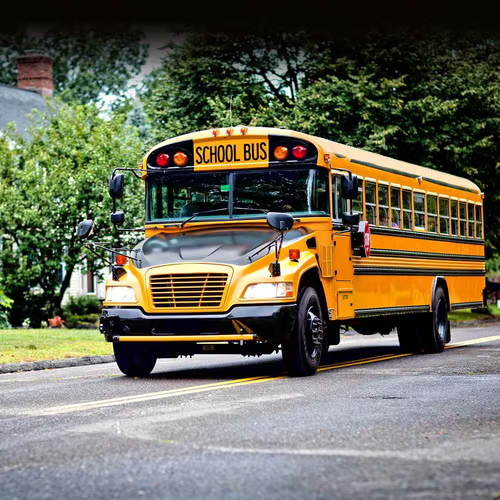
School Bus Drivers’ Day
An appreciation observance on the fourth Tuesday in April recognizing the safety, dedication, and daily contributions of school bus drivers.
California State Assembly
Legislative Resolution
The California State Assembly passed Assembly Concurrent Resolution 58, introduced by Assembly Member Brian Nestande, in 2009 to formally designate the fourth Tuesday in April as School Bus Drivers' Day. The resolution recognized the continued and excellent services provided by school bus drivers to students statewide.

Introduction
The average school bus driver in the United States is 57 years old, works a split shift six hours apart, and is responsible for the safety of up to 72 children per route. School Bus Drivers' Day, observed on the fourth Tuesday in April, directs attention to a workforce that operates the nation's largest public transit fleet with remarkably little public recognition.
More than 55% of the profession is women, and most drivers work part-time split shifts with no year-round employment guarantee. The day originated in California, where the state legislature formalized it in 2009 after years of informal local celebrations.
School Bus Drivers' Day History
The role of the school bus driver in the United States grew out of a basic logistical problem: rural students lived too far from school to walk. In 1869, Massachusetts became the first state to fund public school transportation, hiring farmers to carry children in horse-drawn wagons that locals called "kid hacks." By the early 1900s, motorized trucks began replacing the wagons, and wooden bus bodies gave way to steel frames in the 1920s.
The vehicles were wildly inconsistent. Buses came in every color and configuration, making them difficult for other motorists to recognize on the road. Safety was uneven at best.
A standard color and a safer ride
In April 1939, Frank Cyr, a professor at Teachers College, Columbia University, organized a seven-day conference funded by a $5,000 Rockefeller Foundation grant. Representatives from all 48 states, bus manufacturers, and paint companies attended. They approved 44 national standards covering body length, ceiling height, aisle width, and mechanical specifications. The most enduring outcome was the selection of a single bus color from approximately 50 shades: "National School Bus Chrome," now called National School Bus Glossy Yellow. The color was chosen for maximum visibility in early morning light and bad weather.
Professionalizing behind the wheel
For decades, school bus driving remained loosely regulated. Some southern states even allowed high school students to drive routes. That changed in 1986 when Congress passed the Commercial Motor Vehicle Safety Act, requiring all drivers of large vehicles, including school buses, to hold a federal Commercial Driver's License. The law set minimum training standards and mandated drug and alcohol testing, transforming the role from a casual job into a credentialed profession.
A legislative thank-you from California
School bus drivers had been informally recognized in California for years before the state legislature took formal action. On April 13, 2009, Assembly Member Brian Nestande introduced Assembly Concurrent Resolution 58, specifically citing the "continued and excellent services" drivers provide to students. The Assembly adopted ACR 58 on May 4, the Senate followed on May 14, and the Secretary of State chaptered it as Resolution Chapter 32 on May 20, 2009. The resolution designated the fourth Tuesday in April as School Bus Drivers' Day, and the observance has since spread informally to other states.
School Bus Drivers’ Day Timeline
First public school transportation begins
National school bus standards established
Federal CDL requirement signed into law
Stop arms mandated on new buses
California formalizes the observance
How to Celebrate School Bus Drivers’ Day
- 1
Write a thank-you note for your child's driver
A handwritten card from a student or parent can carry significant weight for someone who rarely receives direct feedback. Encourage your child to mention something specific, like a time the driver kept the bus calm during bad weather or always greeted them by name.
- 2
Organize a school-wide appreciation event
Coordinate with your school's PTA to set up a breakfast, gift card collection, or recognition ceremony in the bus lot. The National PTA offers resources for organizing community events that can be adapted for driver appreciation.
- 3
Learn about school bus safety standards
The National Highway Traffic Safety Administration maintains a dedicated school bus safety page covering stop-arm laws, loading zone rules, and child pedestrian guidelines. Understanding these regulations helps parents reinforce safe habits with their children.
- 4
Explore a career in school bus driving
With a nationwide shortage of over 21,000 drivers, districts are actively recruiting and often offering signing bonuses and paid CDL training. Visit the Bureau of Labor Statistics page on bus drivers for salary data, job outlook, and entry requirements.
- 5
Share school bus history with your students
Use the day as a classroom opportunity to teach children how school transportation evolved from horse-drawn wagons in 1869 to the modern fleet of yellow buses they ride each morning. Columbia University's Teachers College published an account of Frank Cyr's 1939 conference that established the yellow school bus standard.
Why School Bus Drivers’ Day is Important
- A
Drivers operate the largest transit fleet in the nation
Approximately 26 million students ride 480,000 school buses every school day, making it a fleet roughly 2.5 times larger than all other U.S. mass transit systems combined. Each bus covers about 12,000 miles per year, and the network collectively logs nearly 6 billion miles annually.
- B
A persistent workforce crisis threatens student access
As of August 2025, school bus driver employment remained 9.5% lower than 2019 levels, a gap of 21,200 drivers. The shortage has forced 91% of surveyed school district leaders to shorten or eliminate bus routes, pushing transportation burdens onto families and increasing absenteeism.
- C
The profession faces a structural pay gap
The median school bus driver earns 43% less than the median weekly wage for all U.S. workers, according to the Economic Policy Institute. Most positions are part-time with split shifts, and the combination of low pay, rigid hours, and the stress of child safety responsibility has driven a surge in retirements among drivers over 55.
Holiday Dates
| Year | Date | Day |
|---|---|---|
| 2023 | Tuesday | |
| 2024 | Tuesday | |
| 2025 | Tuesday | |
| 2026 | Tuesday | |
| 2027 | Tuesday |